The 19th Century Socio-Religious Reforms - Paving the Path to India's Independence | (Sun 01 Dec 2024 14:30)
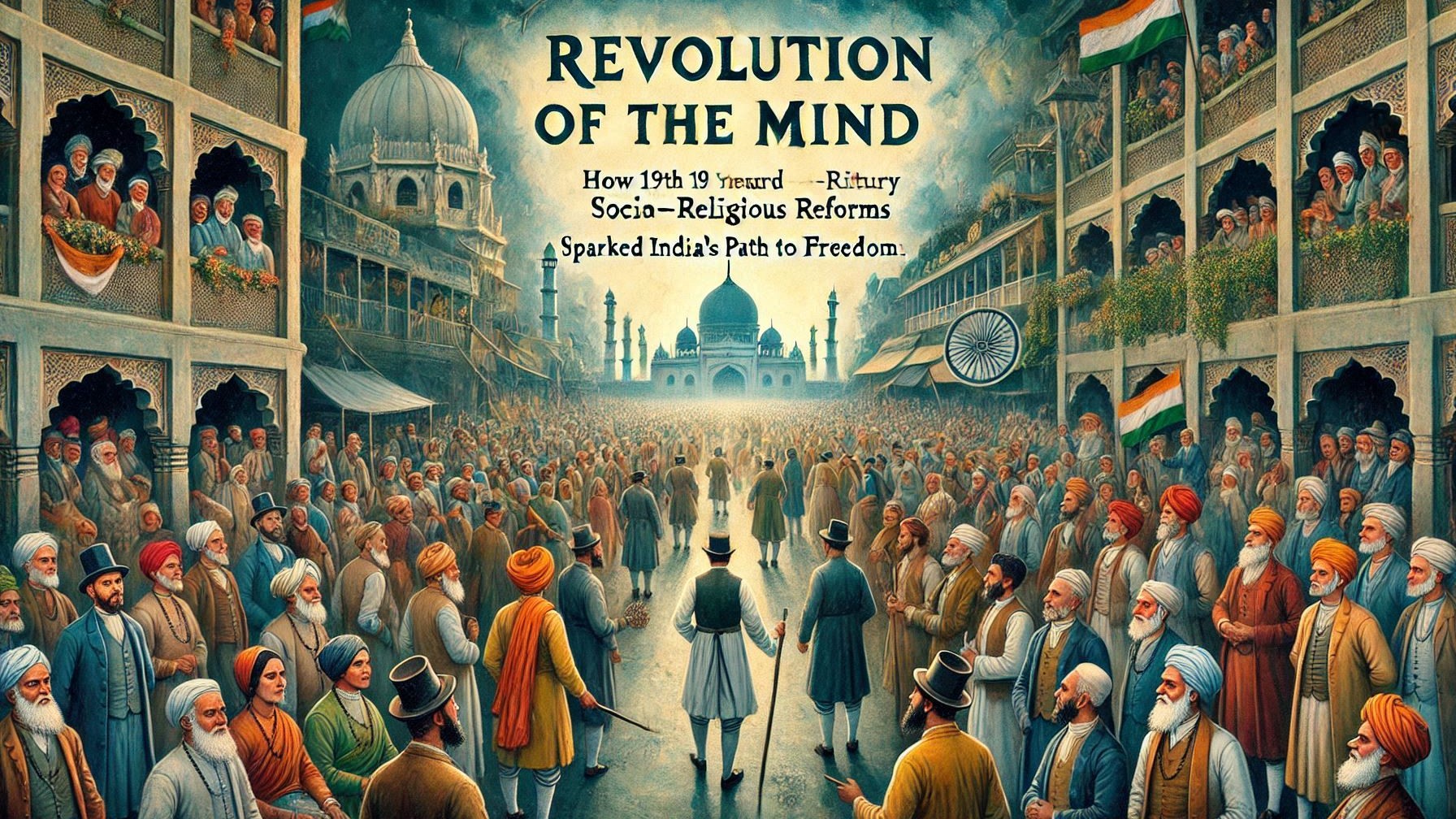
The 19th Century Socio-Religious Reform Movements: Building India's Path to Independence
Imagine a time when society was shackled by oppressive traditions, rigid caste systems, and deeply entrenched superstitions. The 19th century in India was a period of profound change, not just in terms of political struggles but also in how people viewed themselves and their society. Amidst British colonial rule, a group of intellectuals and reformers emerged with a mission to shake up the status quo. They sought to challenge oppressive social practices, revitalize religious practices, and create a foundation for a united, independent India. Their ideas, though rooted in social and religious reform, would eventually provide the intellectual and cultural foundation for India’s national movement.
These reformers weren’t just challenging the British colonialists; they were tackling long-held societal evils, promoting education, rational thinking, and equality, all of which would later play an essential role in galvanizing the masses for India’s freedom struggle.
The Age of Change: Seeds of Reformation
India in the 19th century was a complex tapestry of caste divisions, religious orthodoxy, and colonial subjugation. The British colonialists were tightening their grip on the country, but within this turbulent period arose a flurry of reformers who aimed to change not just the political landscape but the cultural and social fabric of India. Men and women like Raja Ram Mohan Roy, Swami Vivekananda, Jyotirao Phule, and Ishwar Chandra Vidyasagar were pushing against centuries of stagnation, laying the intellectual groundwork for India’s future struggle for independence.
These reformers believed that only a society that was just, inclusive, and rational could hope to be free from colonial rule. They didn’t just want to reform religion; they sought to reform the very soul of Indian society.
The Power of Rationalism and Scientific Thinking
One of the first things these reformers tackled was the deep-rooted superstition and blind religious practices that had pervaded Indian society for centuries. They promoted rational thought, scientific temper, and the importance of education—ideas that would go on to inspire generations of nationalists.
Raja Ram Mohan Roy, often called the “father of the Bengal Renaissance,” was a towering figure in this intellectual revolution. A visionary who saw the potential of a modern India, Roy was fiercely against idol worship, the caste system, and practices like Sati (the ritual burning of widows). Through his organization, the Brahmo Samaj, he introduced the idea of monotheism, rejecting the multiple gods and idol worship that many believed to be essential to Indian religion.
Roy’s ideas didn’t just challenge religious orthodoxy but also set the stage for an India where reason and logic could guide actions. By encouraging rational thinking, Roy gave the first push towards a more enlightened and scientific mindset in India. This rationalist thinking would, over time, spread through society, laying the intellectual groundwork for future social and political movements.
The Battle Against Caste and Inequality
One of the most pressing issues that reformers like Jyotirao Phule and Swami Dayanand Saraswati sought to tackle was the oppressive caste system. For centuries, the caste hierarchy had relegated large sections of society, particularly the Dalits (formerly called "untouchables"), to the lowest rungs, denying them basic rights and dignity. It was a system that reinforced inequality and kept millions trapped in poverty and oppression.
Jyotirao Phule, a champion for the rights of the oppressed, founded the Satyashodhak Samaj (Society of Seekers of Truth). Phule’s primary mission was to empower lower-caste communities, particularly women, through education and social reform. He believed that knowledge was the key to breaking the chains of caste-based discrimination. He worked tirelessly to bring education to the marginalized, often at great personal risk. Phule’s ideas ignited a sense of unity and solidarity among the oppressed, who began to see themselves not as inferior beings but as part of a larger, collective struggle for dignity and justice.
Meanwhile, Swami Dayanand Saraswati, the founder of the Arya Samaj, advocated for the abolition of the caste system and supported the idea of social equality. Through his powerful writings and speeches, he promoted the idea that all people, regardless of caste or creed, were equal in the eyes of God. This message of social justice was revolutionary and inspired many to join the fight for a more equitable society, which would later dovetail with India’s quest for independence.
Empowering Women: A Call for Equality
Another significant dimension of the socio-religious reform movements was the focus on women’s rights. In a society where women were subjected to child marriage, illiteracy, and oppressive practices like Sati, the reformers were firm in their call for gender equality and women’s empowerment.
Ishwar Chandra Vidyasagar was one of the key figures in this battle. As an educator, he passionately advocated for women’s education and campaigned for the remarriage of widows. His tireless efforts led to the Widow Remarriage Act of 1856, a landmark piece of legislation that challenged centuries-old social norms. Vidyasagar also worked to open schools for girls and believed that a society that educated its women would thrive and prosper.
Other reformers, such as Swami Vivekananda, also emphasized the importance of uplifting women and gave them a central role in the societal reform process. Vivekananda’s famous words, “There is no chance for the welfare of the world unless the condition of women is improved,” resonated deeply with many and strengthened the case for gender equality in India’s fight for freedom.
Rediscovering India’s Glorious Past
While these reformers were challenging oppressive social practices, they were also looking back to India’s rich cultural and intellectual heritage. Swami Vivekananda, in particular, called upon the masses to draw strength from India’s ancient traditions and philosophical wisdom. In his famous speech at the Chicago World Parliament of Religions in 1893, Vivekananda extolled the greatness of Indian spirituality and thought. He encouraged Indians to regain their self-respect and confidence, believing that India had the potential to be a spiritual and intellectual leader in the world.
Vivekananda’s message of pride in India’s past, combined with his call for social reform, helped foster a sense of cultural nationalism. This pride in India's heritage would later be a powerful force that unified the people of India during the freedom struggle.
The Rise of Vernacular Languages and Literature
The 19th century reformers also understood the importance of language in uniting the masses. While English was the language of the educated elite, reformers promoted the use of vernacular languages so that their ideas could reach a broader audience. Writers like Bankim Chandra Chattopadhyay played a critical role in this movement. Chattopadhyay’s famous work Anandamath, which included the patriotic song “Vande Mataram,” became a rallying cry for freedom fighters. The song symbolized the fusion of cultural pride and the yearning for independence, echoing the growing sentiment of nationalism that would soon engulf the nation.
Secularism and Unity in Diversity
The reform movements also played a pivotal role in promoting secularism and communal harmony. At a time when British colonial policies often emphasized divisions between religious communities, reformers like the Prarthana Samaj emphasized the importance of interfaith dialogue and communal unity. They promoted the idea that all religions should coexist peacefully, setting a framework for the inclusive approach that would later become central to India’s independence movement.
Swami Dayanand’s Arya Samaj, with its emphasis on social unity, inter-caste marriage, and respect for all religions, provided an ideological foundation for the secular, inclusive vision of the Indian National Congress.
Laying the Groundwork for the Freedom Struggle
The socio-religious reform movements of the 19th century were not just about social justice or religious revival; they were about creating the intellectual, cultural, and philosophical foundation for India's national movement. Reformers like Raja Ram Mohan Roy, Swami Vivekananda, Jyotirao Phule, Ishwar Chandra Vidyasagar, and others didn’t just change individual lives—they sparked a movement that united India’s diverse peoples under a common banner of freedom, justice, and equality.
Their work laid the groundwork for the rise of a nationalist consciousness that would, in time, transform into a full-fledged struggle for independence. Their ideas—of rationality, social equality, women’s empowerment, cultural pride, and religious harmony—became the cornerstone of India's fight against British colonial rule. In essence, the 19th-century socio-religious reforms were not only a fight for social justice but also the intellectual foundation for India’s national identity and its path to freedom.

Physics, Chemistry, Biology and Geography.

Computer Programming, languages & their frameworks.

Economics, Accounts and Management.

Reviewing old and new books.

Ancient, Medieval, Modern, World History.
Indian Constitution, Politics, Policies, etc.

Everything related to International Affairs.

For all humanities topics, except History & Polity.

Anything related to entertainment industry.
Mainly Cricket but other sports too.

CS, IT, Services & Corporate Sector.
Comments
No comments yet. Be the first to comment!
Leave a Comment