The Endless War in Hormuz, US-Iran Stalemate, Houthi Advances, and the Global Energy Crisis Unfolding in 2026 | (Fri 18 Sep 2026 05:44)
From Trump’s Four-Week Forecast to Maritime Blockades, Proxy Escalations, and Rising Oil Prices Reshaping Alliances Across the Region.
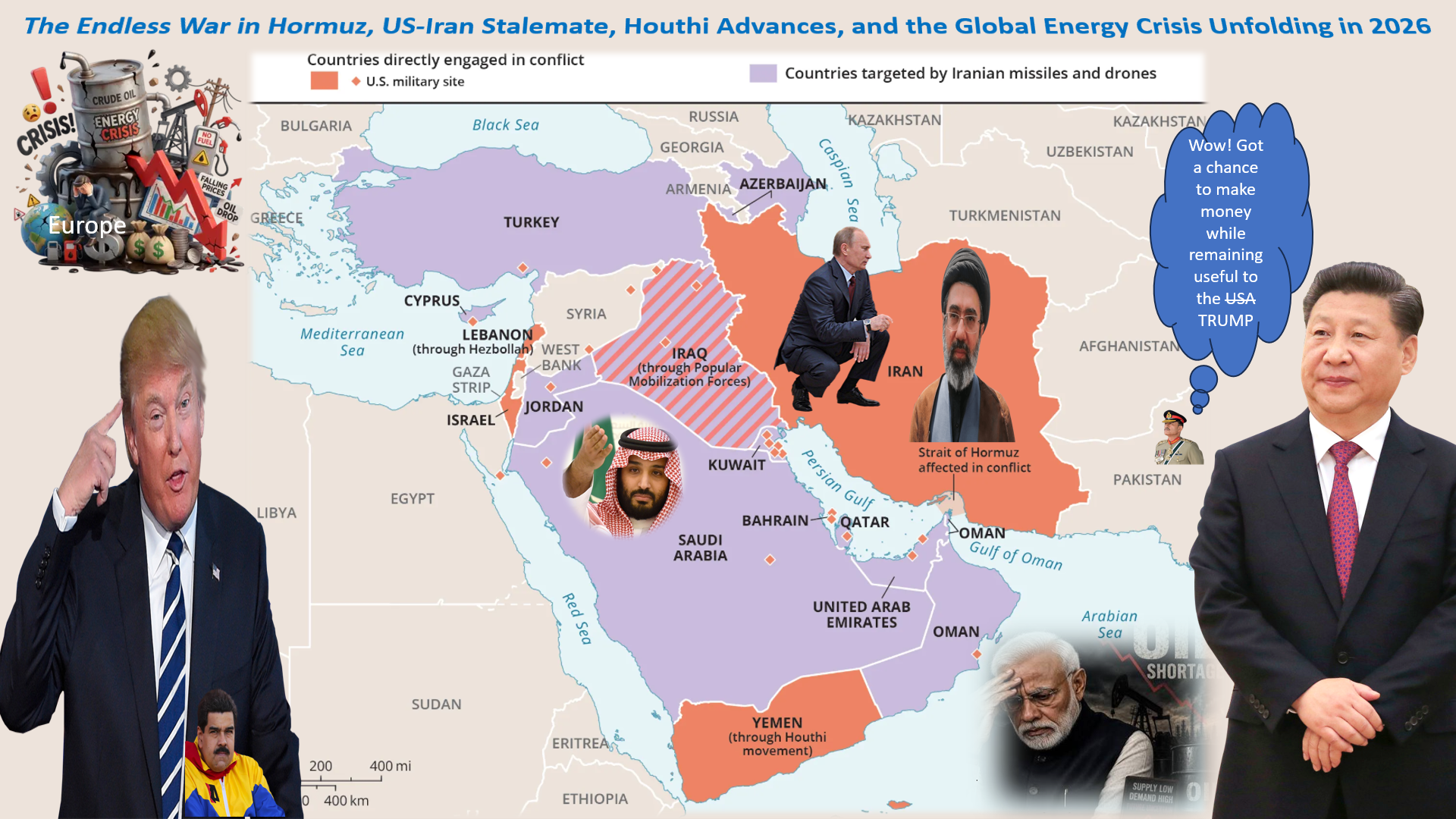
Seven months after the opening salvos of Operation Epic Fury, the conflict that President Donald Trump once predicted would last four or five weeks has hardened into a grinding contest of wills with no obvious off-ramp. What began as a joint U.S.-Israeli campaign to degrade Iran’s military and nuclear infrastructure has metastasized into a dual-theater maritime crisis that now grips both the Strait of Hormuz and the Bab el-Mandeb. Global energy markets are convulsing, regional alliances are fracturing and realigning, and the war’s secondary effects are beginning to reshape the balance of power from the Black Sea to the Indian Ocean.
The immediate military picture is defined by stalemate at sea. In early September 2026, U.S. forces struck Iranian naval assets and tankers; Tehran answered by tightening a de facto blockade of the Strait of Hormuz. Kpler data captured the result with brutal clarity: daily vessel traffic collapsed from a pre-war average of 138 ships to as few as four or five. Former U.S. official Daniel Benaim has described a “foot race” between American escort efforts and Iran’s evolving tactics of dynamic interference. Simultaneously, Yemen’s Houthi movement shattered a four-year informal cease-fire with the Saudi-backed government, seized Perim Island in the Bab el-Mandeb, and established a second choke-point over the primary alternate route for tankers seeking to bypass Hormuz. The dual closure of the world’s two most critical energy corridors has forced shippers onto the Cape of Good Hope diversion, an extra fifteen days of steaming that inflates insurance premiums and fuel costs while stretching Suez Canal logistics to the breaking point for very large crude carriers.
Oil prices have responded as expected. Benchmarks that hovered near $70 before the war have surged past $100 a barrel. American diesel has climbed toward $6 a gallon. The Congressional Budget Office estimates the direct U.S. military cost at roughly $38 billion so far, with monthly outlays potentially reaching $3 billion if the intensity continues. These numbers are not abstractions; they feed inflation, squeeze household budgets, and force governments from New Delhi to Tokyo to scramble for alternative supplies.
Watching the White House and Tehran address the press is like reading two neural networks trained on entirely different planets.
On Planet Washington, the AI model predicts 'total control of the Strait, a deal coming any minute, and oil dropping like a rock right after the midterms.'
On Planet Tehran, the algorithm outputs 'zero traffic, complete economic leverage via the Red Sea, and no talks until all conditions are met. Period!'
The loss function on both models is currently set to infinite, and neither model is converging on reality.
Diplomacy has lagged far behind the kinetic reality. An interim memorandum of understanding signed in Switzerland in June collapsed within weeks after Iranian strikes on commercial vessels. High-level direct talks have not resumed. Trump, speaking in Charlotte, offered characteristically mixed signals, “Hopefully we’re toward the end of the war… Iran is very much wanting to make a deal”; while Iranian officials, including Supreme National Security Council Secretary Mohsen Rezaei, have insisted that no negotiations will occur until Tehran’s conditions are met. Analysts at Chatham House note that Iran’s leadership, free of electoral calendars, can afford to play for time, leveraging higher energy prices as a form of strategic pressure on Western economies.
The regional geometry is more complex still. The Gulf Cooperation Council states find themselves caught between American security guarantees and the tangible threat of Iranian missiles and drones. Saudi Arabia, already locked in a long-running proxy struggle with the Houthis, has seen that conflict reignite along its southern border and even threaten the approaches to Mecca. Air defenses intercepted a Houthi drone south of the holy city in mid-September; Riyadh responded with hundreds of airstrikes across Yemen. The Shia-Sunni fault line, never fully dormant, has been reactivated. Iran’s network of partners, Houthis in Yemen, Hezbollah in Lebanon, and aligned Shia militias in Iraq, forms a geographic and ideological arc that effectively surrounds the Arabian Peninsula. Saudi Arabia’s response has included intensified military pressure and a renewed emphasis on Islamic solidarity, most visibly through closer coordination with Turkey and Pakistan under what some observers have begun calling a “Mecca understanding” aimed at protecting the Haramain and containing Iranian influence.
Israel’s angle remains decisive. The original February 2026 strikes that killed Ayatollah Ali Khamenei were a joint U.S.-Israeli operation. Subsequent Iranian retaliation targeted U.S. bases and infrastructure across the Gulf, while Israel has continued to manage the northern front against Hezbollah and the residual threat from Iranian proxies. The war has also complicated Israel’s longer-term calculus: every week of attrition depletes interceptor stockpiles and raises the domestic political cost of an open-ended conflict.
Trump’s personal imprint is unmistakable. His decision to authorize the February offensive, the subsequent rejection of a Senate war-powers resolution, and his public insistence on “almost total control” of Hormuz have shaped both the tempo of operations and the domestic political framing. At the same time, his administration has floated aggressive economic measures, tariffs on oil imports from countries that continue to purchase Iranian crude and a push to flood markets with additional Venezuelan barrels once production and sanctions constraints can be eased. The Venezuela “oil dump” is still more aspiration than reality, constrained by infrastructure and political risk, yet the mere signal has already altered market psychology. Trump’s approach is transactional and maximalist: pressure Iran until it yields, while using energy leverage to force third parties to choose sides.
Iran’s resilience, however, has surprised many. Despite the loss of its long-time Supreme Leader, the succession of Mojtaba Khamenei, and the destruction of significant military and nuclear assets, Tehran has maintained asymmetric capacity. Missile and drone campaigns against Gulf bases, the shadow fleet that continues to move oil, and the ability to activate proxies have kept the costs of the war high for its adversaries. The regime’s calculation appears to be that time and economic pain will eventually force Washington toward a negotiated outcome more favorable to Iranian red lines.
What is India’s position?
Illustrates the dilemma facing major energy importers. Roughly 85% of its oil and a large share of its LPG arrive via routes that pass through or near the contested straits. Shortages of commercial LPG have already forced restaurant closures and distribution queues in major cities. New Delhi has responded with quiet diplomacy, securing at least one exceptional passage for an Indian-flagged tanker carrying 40,000 metric tons of LPG under naval escort, an early diplomatic success. Yet the structural vulnerability remains. India has also used the crisis to deepen energy ties with alternative suppliers while carefully calibrating its language in multilateral forums.
That multilateral dimension now includes BRICS. The 2026 summit in New Delhi brought Iranian and Chinese foreign ministers together on the sidelines. Beijing has urged restraint and a return to earlier understandings, while privately continuing to absorb discounted Iranian oil. Russia, locked in its own grinding war in Ukraine, watches the Middle Eastern crisis with mixed feelings. Higher global oil prices provide fiscal relief for Moscow’s war chest, yet the diversion of Western attention and munitions toward the Gulf may ease some pressure on Ukrainian battlefields. Simultaneously, any prolonged disruption of Middle Eastern supply routes complicates logistics for countries that had previously balanced Russian and Gulf crude. The net effect on the Russia-Ukraine conflict is therefore ambiguous: economic oxygen for Russia, but also a reminder that great-power bandwidth is finite.
The Struggling of Middle-East
The cumulative result is a Middle East more fractured and more interconnected than at any point since the 1980s tanker wars. The Houthis’ control of Perim Island links the Red Sea crisis directly to Hormuz. The attempted drone approach to Mecca has drawn Pakistan and Turkey into sharper rhetorical and potentially operational solidarity with Riyadh for Mecca Pact. Yemen's escalation highlights the disconnect between a stated defense commitment as 'Mecca Pact', and a regional mechanism actually equipped to protect its members and negotiate peace. Hezbollah and Iraqi Shia militias remain latent but available instruments of pressure. Oil prices above $100 impose inflationary taxes on every major economy. And the absence of a credible diplomatic track means that each new incident..another intercepted drone, another strike on a commercial vessel, another public statement from Tehran or Washington, risks further escalation.
Seven months in, Operation Epic Fury has settled into a contest of endurance. Iran believes rising energy costs will eventually compel Western compromise. The United States and its partners believe sustained military and economic pressure will force Tehran to abandon maximalist demands. Between those two assessments lies a region whose traditional security architecture is under strain, a global energy system forced into costly work-arounds, and a set of secondary conflicts, from Yemen to Ukraine, whose trajectories are being quietly rewritten by events in the Gulf. The war that was supposed to be short has become the defining geopolitical fact of 2026, and its consequences are only beginning to compound.
Washington and Tehran can sign all the interim deals they want, but if Israel and Iran are still at war, the fuse is still lit.

Physics, Chemistry, Biology and Geography.

Computer Programming, languages & their frameworks.
Economics, Accounts and Management.

Reviewing old and new books.

Ancient, Medieval, Modern, World History.

Indian Constitution, Politics, Policies, etc.
Everything related to International Affairs.

For all humanities topics, except History & Polity.

Anything related to entertainment industry.

Mainly Cricket but other sports too.
CS, IT, Services & Corporate Sector.
Comments
No comments yet. Be the first to comment!
Leave a Comment