The Journey of Humanity - From Ancient Origins to Global Dominance | (Tue 10 Dec 2024 18:59)
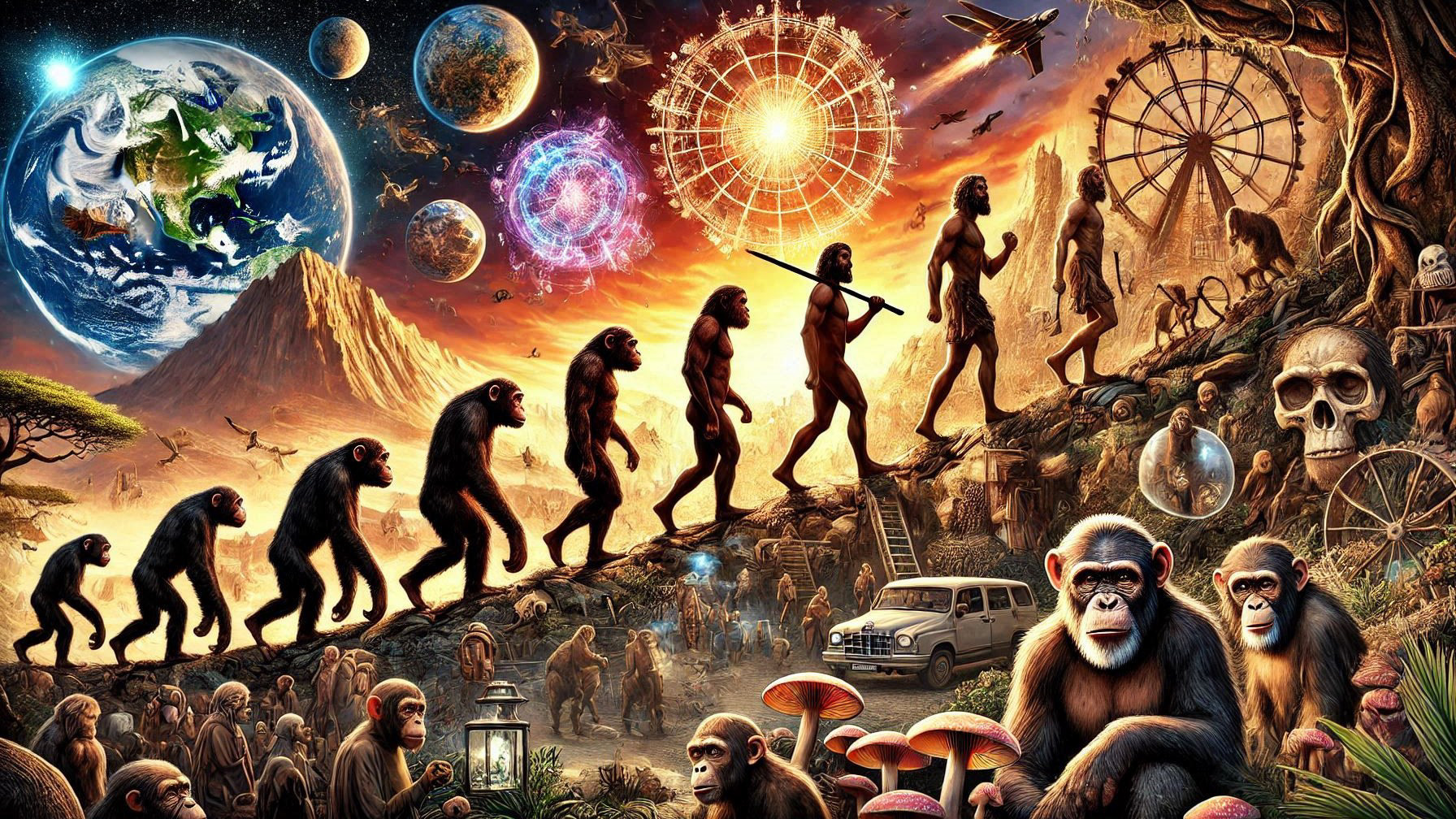
In the depths of South Africa's Taung limestone quarry, more than a century ago, a discovery was made that would change our understanding of the human story forever. It was an accident. Mine workers unearthed a small fossilized cranium, revealing the skull of a child that lived 2.8 million years ago. This child, known to us as the Taung Child, had a face with human-like teeth, and its anatomy hinted at something profound: an early hominin who walked upright. This small piece of fossil evidence offered the first glimpse of an evolving species, showing us that our ancient ancestors had already started to move away from the trees and onto the ground, walking on two legs – a defining trait of humanity.
But this was just the beginning of the journey. The quest to understand human origins has taken paleontologists and archaeologists on a trail of remarkable discoveries, each one unlocking more of our mysterious past. The story of humanity’s evolution, full of twists and turns, begins in Africa – the cradle of humankind – and takes us to every corner of the globe. It's a story not only about the physical transformation of our ancestors but also about the complex web of behaviors, innovations, and social structures that laid the foundation for modern humans.
The Dawn of Hominins: From Taung to Lucy
The Taung Child was not the only early hominin to be discovered in Africa. About 50 years later, in the hot, arid landscape of the Afar region in Ethiopia, a small, ancient female hominin would be uncovered, forever altering our understanding of human evolution. This fossil, affectionately known as Lucy, was part of the species Australopithecus afarensis, and she lived more than 3 million years ago. Her discovery was nothing short of a revelation. Lucy's skeleton, though small and with a brain size similar to that of modern chimpanzees, provided clear evidence that our ancestors had been walking upright long before the development of larger brains.
Lucy became the poster child of the paleoanthropological world, capturing the imagination of both scientists and the public alike. At the time, she was the oldest evidence of bipedalism ever discovered, a key feature in the evolutionary journey towards modern humans. Yet Lucy, though remarkable, was not alone. She was part of a vast and varied family of hominins, with many species living in Africa over millions of years. These species, including others of the Australopithecus genus, were the foundation for the diverse human ancestors that would follow.
As scientists dug deeper into the layers of the Earth, more hominin fossils began to emerge, pointing to an exciting and complex picture of evolution. One such discovery was Ardipithecus ramidus, a species that lived 4.4 million years ago in Ethiopia. Ardipithecus, with its apelike feet and divergent big toe, was still very much adapted to life in the trees. It wasn't yet the fully bipedal creature that Lucy represented, but it was a crucial stepping stone on the path to humanity. And this was the early puzzle piece in a much bigger picture: the idea that multiple hominin species coexisted, each with its own unique adaptations.
The Rise of Australopithecines and the Diversity of Early Humans
As scientists began to unearth fossils from different parts of Africa, it became clear that human evolution was not a simple, linear path. Instead, it was a story of diversification and adaptation. The genus Australopithecus alone is now represented by at least ten species, showcasing a remarkable variety of forms. These hominins were fully bipedal, their teeth displayed a pattern similar to modern humans, and they lived across a wide range of habitats. From the southern tip of Africa to the east and even to the west, near Lake Chad, the australopithecines had spread across vast regions, demonstrating how adaptable and resilient early humans were.
The oldest known species of Australopithecus, A. anamensis, was discovered in northern Kenya, dating back to over 4 million years ago. Just a little later came A. afarensis, the species to which Lucy belonged. In southern Africa, other species such as A. africanus and A. garhi provided evidence of the wide diversity within the genus. Some australopithecines were smaller and more gracile, while others, known as the “robusts,” were massive and adapted for chewing tough plant material. These robust australopithecines were often classified into the genus Paranthropus, and their enormous molar teeth suggest they had a diet of coarse grasses and sedges. Their jaws were so powerful that their incisors and canines shrank over time, a sign that their diet had adapted to a new, less flexible food source.
Though these hominins lived millions of years ago, their fossils continue to shed light on how early humans adapted to various environments, developed distinct physical traits, and diversified across the African continent. Yet, despite their differences, all these species shared one key feature: bipedalism. Walking on two legs was not just a minor trait; it was the defining characteristic that set hominins apart from their primate relatives and opened the door for the evolution of larger brains, tools, and social structures.
The Brain Expands: From Homo Erectus to Homo sapiens
While early hominins like Australopithecus had small brains, the next major leap in human evolution would be the development of larger brain sizes, beginning with Homo erectus. Homo erectus, a species that appeared around 1.9 million years ago, marks the dawn of true humanity. With a brain that was roughly double the size of earlier hominins, Homo erectus demonstrated the first signs of advanced intelligence, including the use of tools and the control of fire. The evolution of a larger brain was a costly one – it required more energy, which in turn required a high-quality diet and efficient food processing. As hominins began to use fire for cooking, they were able to obtain more calories from their food, fueling their growing brains.
The evolution of Homo erectus was not a sudden event; it was a gradual process. The species lived across Africa, Asia, and Europe, adapting to various climates and environments. Evidence suggests that Homo erectus began to spread out of Africa around 1.8 million years ago, marking the beginning of human migration. This is one of the key moments in the human story: the moment when our ancestors began to explore and settle in new territories.
As the brains of early humans grew larger, so did their ability to manipulate their environment. Tools became more sophisticated, and evidence of long-distance transport of materials indicates that early humans were capable of planning and coordinating tasks. Around 400,000 years ago, Homo heidelbergensis emerged, a species with an even larger brain, which was the direct ancestor of both Neanderthals and modern humans. By this time, humans were developing the skills needed to craft weapons, hunt large animals, and engage in more complex social behaviors.
Modern Humans Emerge: The Great Leap Forward
The story of human evolution takes an even more remarkable turn when we reach Homo sapiens, the species to which we belong. For much of the 20th century, the origins of modern humans were debated. Some theories suggested that Homo sapiens emerged around 40,000 years ago in what is now known as the “human revolution” – a sudden burst of creativity marked by the creation of cave art and sophisticated tools. But as dating techniques advanced, new evidence began to show that Homo sapiens appeared much earlier, around 300,000 years ago in Africa.
This discovery reshaped our understanding of human evolution. Early modern humans, it turned out, coexisted with other hominin species, including the Neanderthals in Europe and the Denisovans in Asia, for tens of thousands of years. Genetic evidence now shows that early modern humans interbred with these species, leaving traces of Neanderthal and Denisovan DNA in our own genomes. This suggests that our ancestors were not solitary pioneers; they lived in a world filled with other human-like species, and their interactions were crucial to the development of our modern genetic heritage.
As Homo sapiens began to spread out of Africa around 100,000 years ago, the world underwent profound changes. Our ancestors reached Europe, Asia, and eventually the Americas. They adapted to different environments, developed agriculture, and created the foundations for the great civilizations of the ancient world.
The Legacy of Human Evolution: A Global Journey
The history of human evolution is a story of remarkable adaptation, survival, and transformation. From the humble beginnings of small-brained primates in Africa to the global spread of modern humans, our ancestors faced challenges that shaped their bodies, minds, and cultures. The development of tools, the control of fire, the creation of art, and the rise of language are just a few of the key innovations that allowed humans to thrive in diverse environments.
But the story of human evolution is not just about our past; it is also about our future. Today, as we face unprecedented challenges such as climate change, overpopulation, and technological disruption, we must look back to the resilience and ingenuity of our ancestors. Just as they adapted to their ever-changing world, we too must find new ways to live sustainably, work together, and continue our journey forward as a species.
In the end, the story of humanity is not just a tale of survival; it is a testament to the power of innovation, cooperation, and curiosity. It is a story that continues to unfold, and as we look to the future, we must carry forward the lessons of the past while embracing the opportunities and challenges of the present. Our shared history reminds us that resilience, creativity, and collaboration have always been the keys to progress. By fostering a sense of unity and a commitment to stewardship—of both our planet and our shared humanity—we can shape a future that honors the journey of our ancestors while forging a path toward greater understanding, equity, and sustainability.
The story of human evolution is far from over; it is a living narrative, one that each of us contributes to every day. Together, we can ensure that this story remains one of growth, discovery, and hope, leaving a legacy for future generations to build upon.
Physics, Chemistry, Biology and Geography.

Computer Programming, languages & their frameworks.

Economics, Accounts and Management.

Reviewing old and new books.

Ancient, Medieval, Modern, World History.

Indian Constitution, Politics, Policies, etc.

Everything related to International Affairs.

For all humanities topics, except History & Polity.

Anything related to entertainment industry.

Mainly Cricket but other sports too.

CS, IT, Services & Corporate Sector.
Comments
No comments yet. Be the first to comment!
Leave a Comment