Beyond the Boundary - The Intense India-Pakistan Cricket Rivalry Fueled by Politics, War, Terrorism, Diplomacy and Passion | (Fri 06 Dec 2024 15:51)
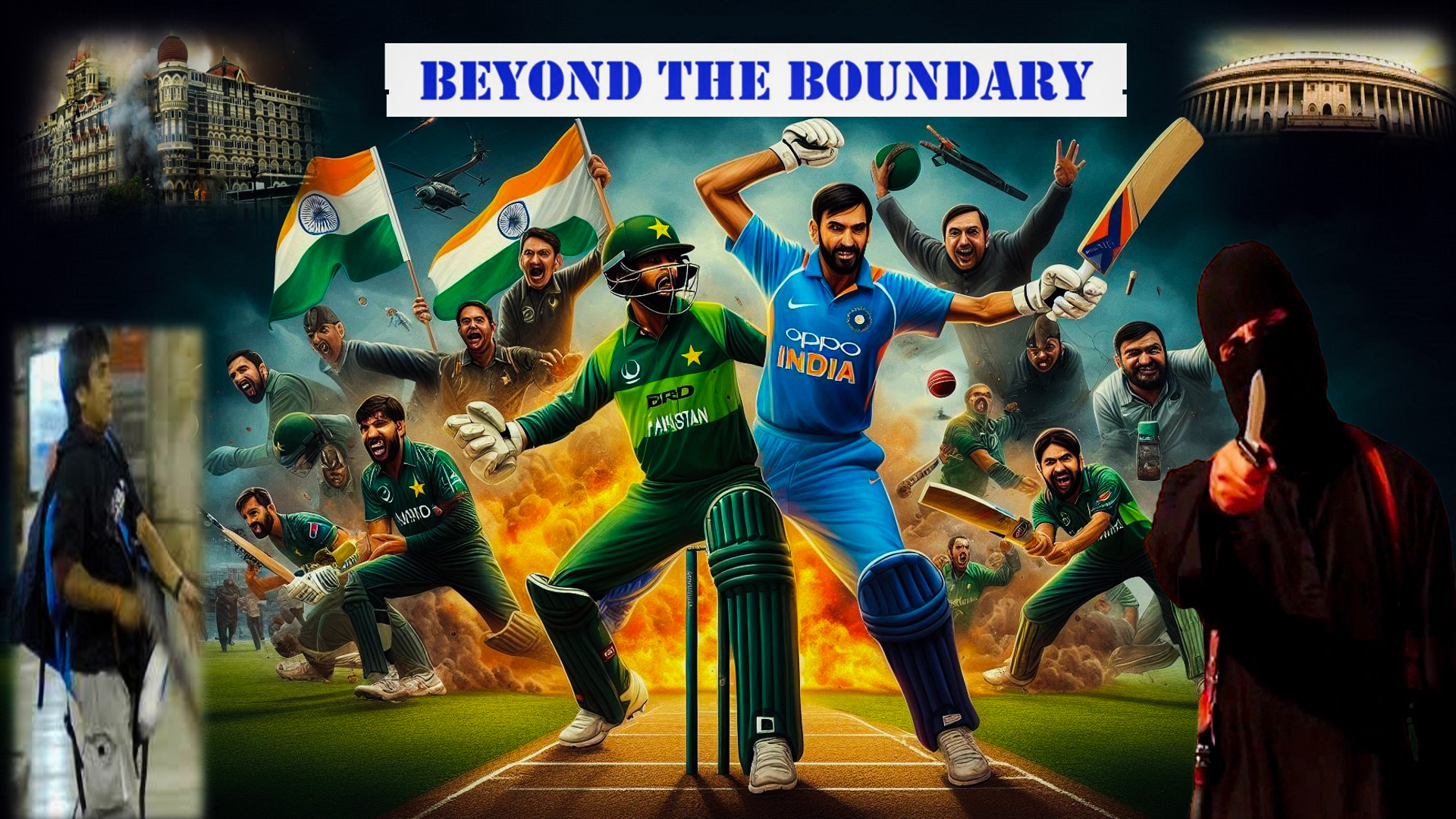
Cricket, for many, is just a game. But for India and Pakistan, it’s far more than that – it’s a high-stakes clash that reverberates with the weight of history, politics, and national pride. No cricket match draws the global attention or stirs the emotions that an India vs Pakistan clash does. From fierce competition on the field to the volatile relationship between the two countries off it, the rivalry has been shaped by wars, diplomacy, and the complex political landscape of South Asia.
The roots of this bitter rivalry trace back to 1947, when British India was divided into two nations—India and Pakistan. The partition was accompanied by widespread violence, displacement, and the beginning of a relationship marked by distrust and hostility. This political divide would influence every aspect of bilateral relations between the two countries, including their sporting ties. While cricket would eventually serve as a channel for diplomacy and peace efforts, it would also become an arena where the tensions of history were played out.
The Birth of a Rivalry: 1952-1953
The India-Pakistan cricket rivalry officially began in the early 1950s. In 1952-53, Pakistan toured India for their first-ever Test series, and a year later, India visited Pakistan for the first time. The matches were closely contested, though neither side emerged victorious in a five-match series, which ended in a stalemate. Similar results followed in the 1955 and 1960-61 series, where both teams were unable to dominate on the field amid rising political tensions between the two nations.
Though the teams were playing cricket, the shadow of political rivalry loomed large. Cricket, once a medium of friendly competition, now became a symbol of national pride and one-upmanship. In this charged atmosphere, every ball bowled and every run scored became a reflection of the deeper divide between the two nations.
Wars, Diplomacy, and a Long Pause: 1965-1978
In 1965, India and Pakistan went to war over the Kashmir region, and cricket came to a halt. The bitter 1971 war, which led to the creation of Bangladesh, further deepened the animosity, and cricketing ties were frozen for more than a decade. It wasn’t until 1978 that cricket resumed, as both countries tentatively began exploring ways to normalize relations. However, the political environment remained hostile, and the frequency of cricket series was sporadic. The two nations only played when it was deemed politically appropriate, and diplomatic efforts were often tied to the cricket series.
One notable episode came in 1987, when Pakistani President Zia-ul-Haq attended a Test match in Jaipur, India, marking a rare moment of engagement between the two countries. Despite the political tensions, cricket seemed to provide a subtle but significant bridge for dialogue, though the backdrop of war and conflict would always keep the rivalry alive.
Sharjah, Neutral Venues, and the Rise of Limited-Overs Cricket: 1980s-1990s
The 1980s and 1990s saw the rise of limited-overs cricket, and with it, the India-Pakistan rivalry took on a new dimension. Neutral venues like Sharjah, Dubai, and Toronto became the battlegrounds for high-stakes encounters between the two teams. The Sharjah Cricket Stadium, often considered Pakistan’s "backyard," became synonymous with thrilling contests, particularly during the Austral-Asia Cup and the Friendship Cup.
Matches in Sharjah drew huge crowds, and the rivalry intensified as both teams regularly faced off in these tournaments. The atmosphere was electric, with fans from both nations filling the stadiums and bringing their nationalistic fervour with them. These limited-overs encounters, with their fast-paced action and high emotions, helped build the rivalry into one of the most intense in world cricket.
World Cups and Suspended Ties: The 1990s-2000s
The advent of multinational tournaments, especially the Cricket World Cup and the ICC T20 World Cup, further fuelled the rivalry. The 1992 World Cup, held in Australia and New Zealand, was particularly significant as it marked the first time the two nations faced each other in a World Cup match. India won the match, but it set the stage for many more encounters between the two teams on the global stage.
However, despite the excitement, cricketing ties between the two countries were frequently suspended due to escalating political tensions. The 1999 Kargil War, in which both nations engaged in a brief conflict over Kashmir, led to the cancellation of planned series. Similarly, the 2008 Mumbai attacks, carried out by Pakistan-based militants, prompted India to sever cricketing ties with Pakistan.
Vajpayee and Musharraf: Cricket as a Tool for Diplomacy
In the early 2000s, despite the ongoing tension, cricket emerged as a potential tool for diplomacy. In a groundbreaking move, Indian Prime Minister Atal Bihari Vajpayee and Pakistani President Pervez Musharraf initiated a peace process. This historic moment led to India’s first tour of Pakistan in 14 years, in 2004, for a five-match One Day International (ODI) series and a three-match Test series. India won both formats, but the significance of this series went far beyond the cricket field. It marked a thaw in relations and signified the potential for cricket to play a positive role in diplomacy.
The 2009 Lahore Attack: A Dark Chapter
However, just as things were looking promising, a terrorist attack in Lahore in 2009 cast a long shadow over Pakistan's ability to host international cricket. The attack on the Sri Lankan cricket team led to a suspension of Test matches in Pakistan for nearly a decade and caused Pakistan to lose its co-hosting rights for the 2011 Cricket World Cup. The incident also deepened India’s reluctance to engage in bilateral cricket, further stalling any efforts for resuming regular encounters.
Cricket as a Bridge: Manmohan Singh and Yousuf Raza Gilani
Despite the challenges, cricket continued to act as a bridge between the two countries. In 2011, Indian Prime Minister Manmohan Singh extended a diplomatic olive branch during the ICC Cricket World Cup semi-final, when India and Pakistan faced off in a high-voltage match. Singh invited Pakistani Prime Minister Yousuf Raza Gilani to watch the match together, symbolizing how cricket could foster dialogue amidst geopolitical tensions. India won the match, but the true victory lay in the possibility of using cricket to mend ties.
Later, in 2012, the Board of Control for Cricket in India (BCCI) invited Pakistan for a short series. However, the series was short-lived as political tensions and security concerns once again put the brakes on regular encounters. Despite a 2014 agreement for six series over eight years, no substantial progress was made.
Iconic Moments Amidst the Rivalry
Even with the challenges, the rivalry between India and Pakistan has produced unforgettable moments. In the 2021 ICC T20 World Cup, Pakistan achieved its first-ever victory over India in a World Cup match, ending a 13-match losing streak. The victory was met with jubilation in Pakistan and disappointment in India, underlining the intensity of this sporting rivalry.
Hybrid Models and the 2023 Asia Cup
The rivalry took another turn in 2023, when the Asia Cup adopted a hybrid model due to India’s refusal to play in Pakistan. Matches were split between Pakistan and Sri Lanka, reflecting the difficulties of hosting such high-profile encounters amidst ongoing political tensions. Similar arrangements are expected for the 2025 Champions Trophy, with India likely playing its matches in the United Arab Emirates.
Pakistani legends, such as Wasim Akram, have often spoken about the desire of fans in Pakistan to see Indian stars like Virat Kohli, Rohit Sharma, and Jasprit Bumrah play on their soil. There is an admiration and respect for Indian cricketers in Pakistan, where fans remember the epic battles of the past with a sense of longing. However, it has now been more than two decades since India last toured Pakistan.
Does threat really exist on Indian Cricket Team OR it's mere a hoax political stunt?
David Headley revealed that Zaki-Ur-Rehman Lakhvi, the Lashkar-e-Taiba commander, orchestrated the 26/11 Mumbai attacks. Despite being jailed, Lakhvi was released on bail and now roams freely in Lahore and Rawalpindi. Lakhvi, listed by the UN for terrorism, uses the alias "Abu Wasi," raising concerns over Pakistan's commitment to justice. Dr. Muhammad Saeed, an assistant professor at Islamabad's NUML, supports terrorist Zaki-Ur-Rehman Lakhvi while moonlighting as a fitness trainer. A recent video showing a bearded man undergoing a fitness test was verified by India's OSINT team using facial recognition, confirming the man was Lakhvi, a wanted terrorist. The footage also featured Dr. Zaid Haris, an Islamic scholar known for discussing religious and humanitarian values in videos. He was seen alongside Dr. Muhammad Saeed, further linking individuals with controversial views to the controversial setting, raising concerns about their associations. About 150+ terrorist entities, individuals, based or linked with Pakistan blacklisted by United Nations, which invokes genuine security threat perception for high potential terrorist target individuals, such as Indian Cricket team members.
Apart from that, the cross-border terrorism by Pakistan in Indian side of Jammu & Kashmir region is intolerable, where soldiers are being martyred during engagement with Pakistan based terrorist. They are Indian and humans too and it's inhuman to look beyond their supreme sacrifices just to play cricket.
The Current ICC Champions Trophy 2025 Fiasco
The International Cricket Council (ICC) is expected to finalize the hybrid model for the Champions Trophy before mid December, presided over by ICC Chair Jay Shah. The 15-game championship will likely adopt a two-nation format, with matches played in Pakistan and the UAE. Five games, including India's three league matches and two knockout games (a semifinal and the final), are set to take place in the UAE.
The Pakistan Cricket Board (PCB), initially opposing the model, has reportedly agreed to it but placed several demands. These include applying the hybrid model to future ICC events hosted by India, compensation for relocating games, and organizing a tri-series involving India at a neutral venue. However, key demands—such as the tri-series and ensuring India and Pakistan are in separate groups—are unlikely to be accepted. An India-Pakistan clash, a cash cow and lucrative fixture for broadcasters, is confirmed for March 1 at the Dubai International Stadium. The formal announcement of the model's acceptance is expected after the 12th December ICC meeting.
The Future of the Rivalry
The India-Pakistan cricket rivalry is far from over due to the same intense conflicts. While political and security concerns continue to impede bilateral cricket, the two nations will likely continue facing off in global tournaments like the ICC World Cup and the Asia Cup. Cricket, for better or for worse, remains one of the few arenas where both countries come together to compete, and as history has shown, it’s a rivalry shaped by more than just the game itself—it’s a reflection of the complex, emotional, and often contentious relationship between the two nations. Though unlike erstwhile, in recent times more than for competitiveness of game, Indians watch those matches just to get the joyous feeling of beating Pakistan, as most matches are one-sided in favour of India post 2003 onwards. The two sides have played a total of 207 times. Pakistan has won 88 matches compared to India's 75 victories, although India has overwhelmingly dominated Pakistan in ICC World Cups, winning 14 out of 15 matches, with Pakistan securing only one victory. At senior men’s level, India has won 6 ICC trophies (2 Cricket World Cup, 2 T20 World Cup, 2 Champions Trophy), while Pakistan has won 3 (1 Cricket World Cup, 1 T20 World Cup, and 1 Champions Trophy).
As the rivalry moves into the future, there remains hope among fans for a return to regular cricketing encounters, but it seems impossible right now as Pakistan establishment (Pakistan Army, who generally runs their defence & foreign policy) is not looking beyond cross-border terrorism activities. For now though, the India-Pakistan clash in cricket remains a mixture of passion, pride, politics, and, of course, the thrilling uncertainty of the game itself.

Physics, Chemistry, Biology and Geography.

Computer Programming, languages & their frameworks.
Economics, Accounts and Management.

Reviewing old and new books.

Ancient, Medieval, Modern, World History.
Indian Constitution, Politics, Policies, etc.
Everything related to International Affairs.

For all humanities topics, except History & Polity.

Anything related to entertainment industry.
Mainly Cricket but other sports too.
CS, IT, Services & Corporate Sector.
Comments
No comments yet. Be the first to comment!
Leave a Comment