Mother of All Deals, India & EU Strike Gold in a Fractured World. | (Mon 26 Jan 2026 12:47)
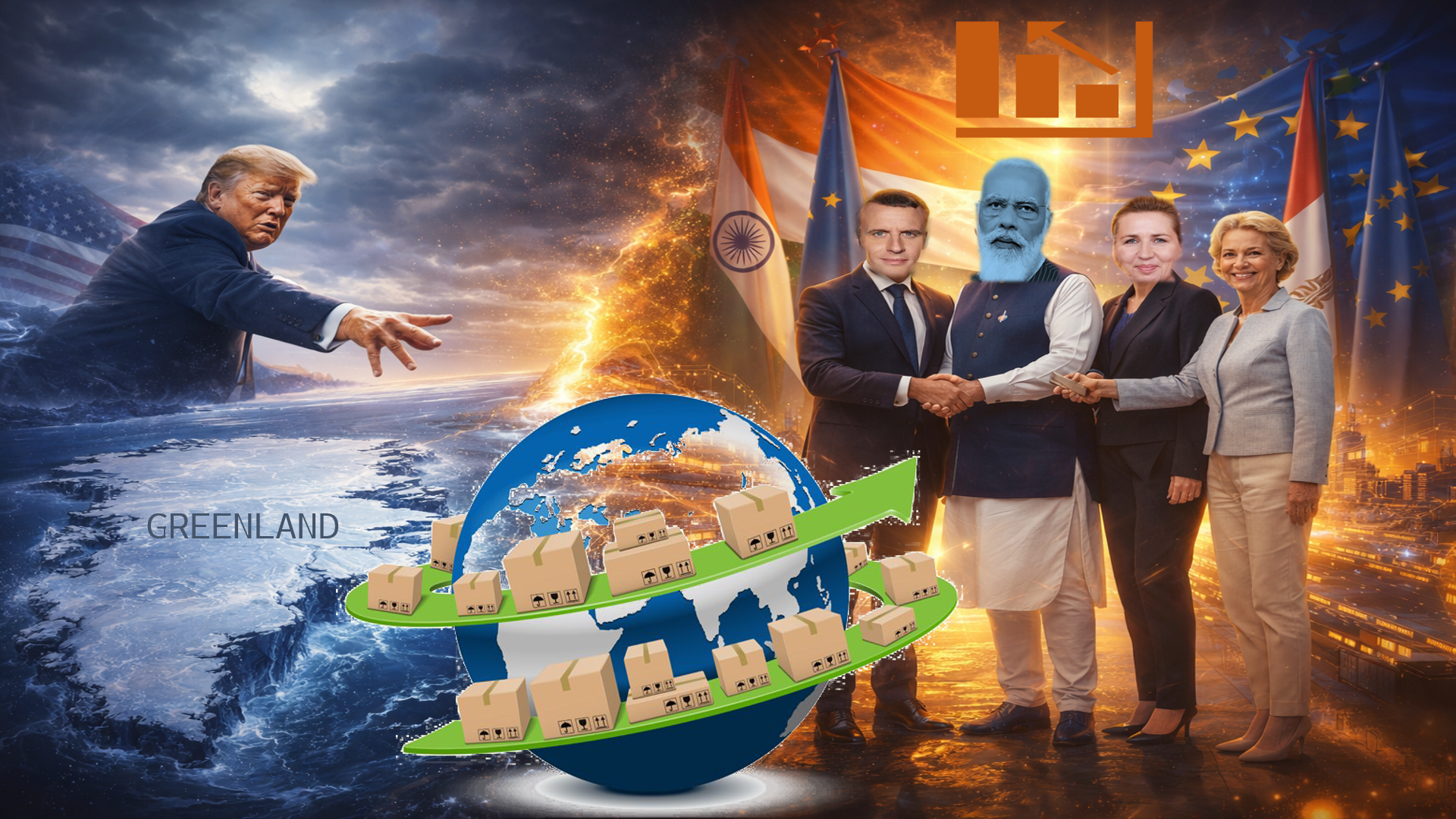
In the heart of New Delhi, under a crisp January sky in 2026, the 77th Republic Day parade unfolded like a vibrant tapestry of India's past and future. European leaders Ursula von der Leyen and Antonio Costa stood as chief guests, their presence more than ceremonial, it was a symbol of shifting global tides. As President Droupadi Murmu hailed India's resilience as the "world's fastest-growing major economy" amid uncertainties, the air buzzed with anticipation for the "mother of all deals": a landmark Free Trade Agreement (FTA) between India and the European Union (EU). This pact, teetering on the edge of finalization, isn't merely about slashing tariffs or boosting exports; it's a grand narrative woven from threads of history, geography, economics, strategy, and even the subtle undercurrents of human psychology. It's a story of two ancient civilizations rediscovering each other in a world fractured by rivalries, where old empires give way to new alliances.
To understand this moment which showed us, one of the largest bilateral trade deals that has happened across the world., we must journey back through time. The seeds were sown in 2000 at the first India-EU Summit in Lisbon, where Prime Minister Atal Bihari Vajpayee articulated a philosophical vision: "A basic symmetry in our circumstances and some core values underpin the India-European Union partnership. We are both global actors in a multi-polar world. We are large multicultural and multilingual federal entities with strong regional identities. We value democracy." Vajpayee, a poet-statesman, saw beyond borders, a Europe healing from World War scars and a India emerging from colonial shadows, both cherishing pluralism in an increasingly polarized globe. Geographically, it made sense: Europe's compact, innovation-driven bloc contrasted with India's vast subcontinent, rich in resources and manpower, separated yet connected by ancient trade routes like the Silk Road. Yet, progress was halting. Negotiations launched in 2007 sputtered by 2013, entangled in disputes over intellectual property, services, and sensitive sectors like agriculture. Societally, Europe's stringent environmental standards clashed with India's developmental priorities, while philosophical differences on human rights added layers of complexity.
What reignited the flame? Enter Donald Trump, whose second term in 2025 unleashed a storm of protectionism. His 50% tariffs on Indian goods and threats against the EU over esoteric issues like Greenland disrupted established trade flows. Indirectly, Trump became the villain in this tale, his "America First" isolationism creating a geopolitical vacuum. Psychologically, it tapped into collective anxieties: India's fear of over-reliance on a fickle US market, and the EU's dread of transatlantic rifts. Trump's policies, echoing his first term's chaos, forced a reevaluation. As US-India trade talks stalled, the EU positioned itself as a "reliable partner," as von der Leyen put it at Davos. This wasn't just economics; it was a strategic pivot, accelerating the FTA's revival in 2022. In a twist of irony, Trump's tariffs invoked the deal's success by highlighting the perils of unilateralism, pushing India and the EU toward mutual dependence.
Economically, the FTA promises a symphony of gains. For India, with its $3.5 trillion economy projected to hit $5 trillion by 2027, access to the EU's $20 trillion market is transformative. Tariffs on textiles, footwear, gems, jewelry, and pharmaceuticals, India's export powerhouses, could drop dramatically, potentially adding $100 billion to bilateral trade, already at $190 billion in FY 2025. India exported $75.85 billion in goods and $30 billion in services to the EU, while the EU exported $60.68 billion in goods and $23 billion in services to India. India has a trade surplus of $15.17 billion in 2024-25. IT services, where India leads globally, stand to benefit from easier data flows and professional mobility. But the nuances deepen in agriculture, a sector fraught with historical sensitivities. India, home to 146 million farm holdings, has long shielded its farmers from imports. The deal smartly navigates this: agriculture is largely excluded to protect livelihoods, yet it opens doors for India's export strengths like seafood ($518 million in shrimps to the EU in 2024-25), spices (cumin, turmeric), rice, fruits (grapes), and beverages (coffee, tea). Ashok Gulati, a renowned agricultural economist, argues the EU poses minimal threat compared to the US. Europe's high-cost farming—bolstered by subsidies—makes it uncompetitive in staples like corn or soyabean, unlike America's industrial-scale operations. Premium EU imports like Gouda cheese or olive oil target niche urban markets, not displacing local produce.
Delving into agricultural nuances reveals a tale of inequities and strategies. The OECD's Producer Support Estimate (PSE) paints a stark picture: EU farmers received $97.3 billion annually (16.4% of gross receipts) in 2022-24, including $58.6 billion in direct payments and $16.2 billion in input subsidies. The US provided $38.2 billion (7.1%). India, contrastingly, subsidizes inputs heavily ($47.9 billion), but its PSE is negative $73.1 billion (-14.5%), due to policies depressing farm prices below export parity, a net taxation of farmers. This stems from export curbs, stocking limits, and domestic controls to ensure food security for 1.4 billion people. Philosophically, it's a clash of worlds: Europe's welfare-state model versus India's balancing act between growth and equity. The FTA addresses this by allowing India a 15% "sterilisation duty" to counter EU subsidies, preventing dumping. Societally, it could empower Indian farmers through technology transfers - EU expertise in sustainable farming, like precision agriculture, aligning with India's climate goals. Yet, risks linger: echoes of French farmer protests against the EU-Mercosur deal warn of potential backlash if imports surge. Psychologically, for Indian policymakers, it's about trust—ensuring the deal doesn't exacerbate rural distress, a powder keg in elections.
For the EU, the rewards are equally compelling. Facing stagnation and energy crises post-Ukraine war, Europe gains a dynamic market in India, the "growth center" von der Leyen championed. EU firms in automobiles (seeking tariff cuts on cars), beverages (wines, spirits), and machinery could expand, creating jobs back home. Geographically, India's position as a manufacturing hub—bolstered by "Make in India", diversifies EU supply chains away from overdependence on Asia's giants. Scientifically, collaborations in AI, quantum computing, and space (building on India's ISS missions) could yield breakthroughs; think joint projects with Yale's Priyamvada Natarajan on black holes or dark matter. Societally, it fosters cultural bridges—easier visas for artists, students, and professionals, enriching Europe's multicultural fabric. Philosophically, it reaffirms shared values: democracy in an autocratic shadow, sustainability amid climate peril.
But the plot thickens with the India-China rivalry, a geopolitical undercurrent that elevates this deal to epic proportions. China, India's northern neighbor and economic behemoth, looms large. Border tensions since 1962, amplified by 2020's Galwan clashes, have fueled distrust. Economically, China's dominance in solar panels, electronics, and critical minerals exposes vulnerabilities, India faces dumping, while the EU grapples with overreliance on Chinese tech. The FTA counters this: by deepening ties, India and the EU reduce dependence on Beijing. Strategically, the accompanying security pact, covering maritime security in the Indo-Pacific, cyber defenses, and counter-terrorism, signals a united front. India, the third Asian nation after Japan and South Korea to ink such a deal, gains EU support in forums like the UN, subtly balancing China's influence. Geopolitically, it's a multipolar maneuver: as Trump's US softens on China (focusing westward), the pact fills the void, deterring aggression in the South China Sea or Himalayas. Psychologically, it boosts India's confidence— no longer a junior partner, but a pivotal player. Historically, it echoes Cold War realignments, where alliances shifted to contain threats.
The defence partnership adds layers: annual dialogues, joint naval exercises (like those in the Indian Ocean in 2025), and information-sharing pacts build trust. Amid Ukraine's four-year war, it navigates EU divisions, Baltic states wary of India's Russia ties, yet warming through classified exchanges. Philosophically, it's about resilience: two entities, forged in diversity, choosing cooperation over confrontation in a world of hybrid threats.
Globally, this pact reshapes the narrative. In deglobalization's grip, it creates a mega-market of two billion people, a quarter of world GDP, challenging the US-China duopoly. Economically, it reroutes flows: less Chinese manufacturing hegemony, more equitable chains. Strategically, enhanced cooperation in critical infrastructure (power grids, transport) bolsters security. Geopolitically, it inspires multipolarity, encouraging pacts in Africa or Latin America, diluting superpowers' dominance. Societally, it promotes inclusivity: women's empowerment through trade (India's textile sector employs millions of females), and cultural exchanges healing colonial wounds. Scientifically, joint R&D in biotech or renewables accelerates progress for humanity. Philosophically, it embodies hope - Vajpayee's symmetry in a fractured era. Psychologically, it alleviates isolation: nations feel empowered, not pawns.
Yet, challenges persist. Agricultural nuances demand vigilance, India's negative PSE highlights systemic reforms needed. India will progressively open its market for European goods, including cars and wines, while protecting sensitive sectors. China rivalry could escalate if Beijing retaliates with trade barriers. Trump's shadow lingers, testing the pact's durability.
- The deal touches approximately 1.9 billion people (1.4 billion in India and about 500 million in the EU).
- India and the EU account for 25% of the global economy.
- They make up 30% of the world's population.
- The EU's total imports of goods are $6.9 trillion in 2024. The EU's services imports were $2.9 trillion.
- India's total goods imports were around $750 billion in 2024.
- Together, they account for 11 to 12% of global trade.
- Out of the total global trade of $33 trillion, India and the EU account for $11 trillion.
- The EU market accounts for about 17% of India's total exports, and the bloc's exports to India constitute 9% of its total overseas shipments.
- The 27-nation bloc is a major global trade player, exporting about $2.9 trillion and importing more than $2.6 trillion in goods annually.
- India exported $437 billion in goods and $387.5 billion in services. It imported goods worth $720 billion and services worth $195 billion in 2024-25.
- India's major goods exports to EU in FY2025 included petroleum products (USD 15 billion); electronics ($11.3 billion - smartphone $4.3 billion); textiles ($1.6 billion - garments $4.5 billion); machinery, computer ($5 billion); organic chemicals ($5.1 billion); iron and steel ($4.9 billion), gems and Jewellery ($2.5 billion); pharma ($3 billion); auto parts ($1.6 billion); footwear ($809 million); and coffee ($775 million).
- India plans to slash tariffs on cars imported from the European Union to 40% from as high as 110%, sources said, in the biggest opening yet of the country's vast market as the two sides close in on a free trade pact that could come as early as Tuesday (January 27, 2026).
- The EU is providing a €500 million (approx. $530 million+) support fund over two years to assist India in cutting emissions and transitioning to green energy.
- The EU will remove tariffs on 90% of Indian goods upon implementation, rising to 99.5% within seven years.
- The EU is also a major investor in India. India's cumulative FDI inflows from the EU from April 2000 to September 2024 totalled $117.4 billion, and 6,000 EU firms are present in India. FDI from the EU accounted for over 16.5% of cumulative FDI equity inflows from all countries.
- India's FDI outflows to the EU totalled about $40.04 billion from April 2000 to March 2024.
- This trade pact would be India's largest FTA in both economic size and regulatory scope. As the EU is a customs union, the agreement would give India preferential access to all 27 EU countries under a single framework.
As the parade's echoes fade, this "mother of all deals" isn't just commerce - it's a saga from PM Vajpayee's poetry to PM Modi's pragmatism, catalyzed by Trump's tariffs, tempered by China tensions. India emerges stronger economically and strategically; the EU, more resilient. For the world, it's a reminder: in rivalry's storm, partnerships light the way forward.
Physics, Chemistry, Biology and Geography.

Computer Programming, languages & their frameworks.
Economics, Accounts and Management.

Reviewing old and new books.

Ancient, Medieval, Modern, World History.
Indian Constitution, Politics, Policies, etc.
Everything related to International Affairs.

For all humanities topics, except History & Polity.

Anything related to entertainment industry.
Mainly Cricket but other sports too.
CS, IT, Services & Corporate Sector.
Comments
No comments yet. Be the first to comment!
Leave a Comment