South Korea’s Political Crisis - President Yoon Suk Yeol’s Controversial Martial Law Declaration and the Impeachment Battle | (Wed 04 Dec 2024 23:35)
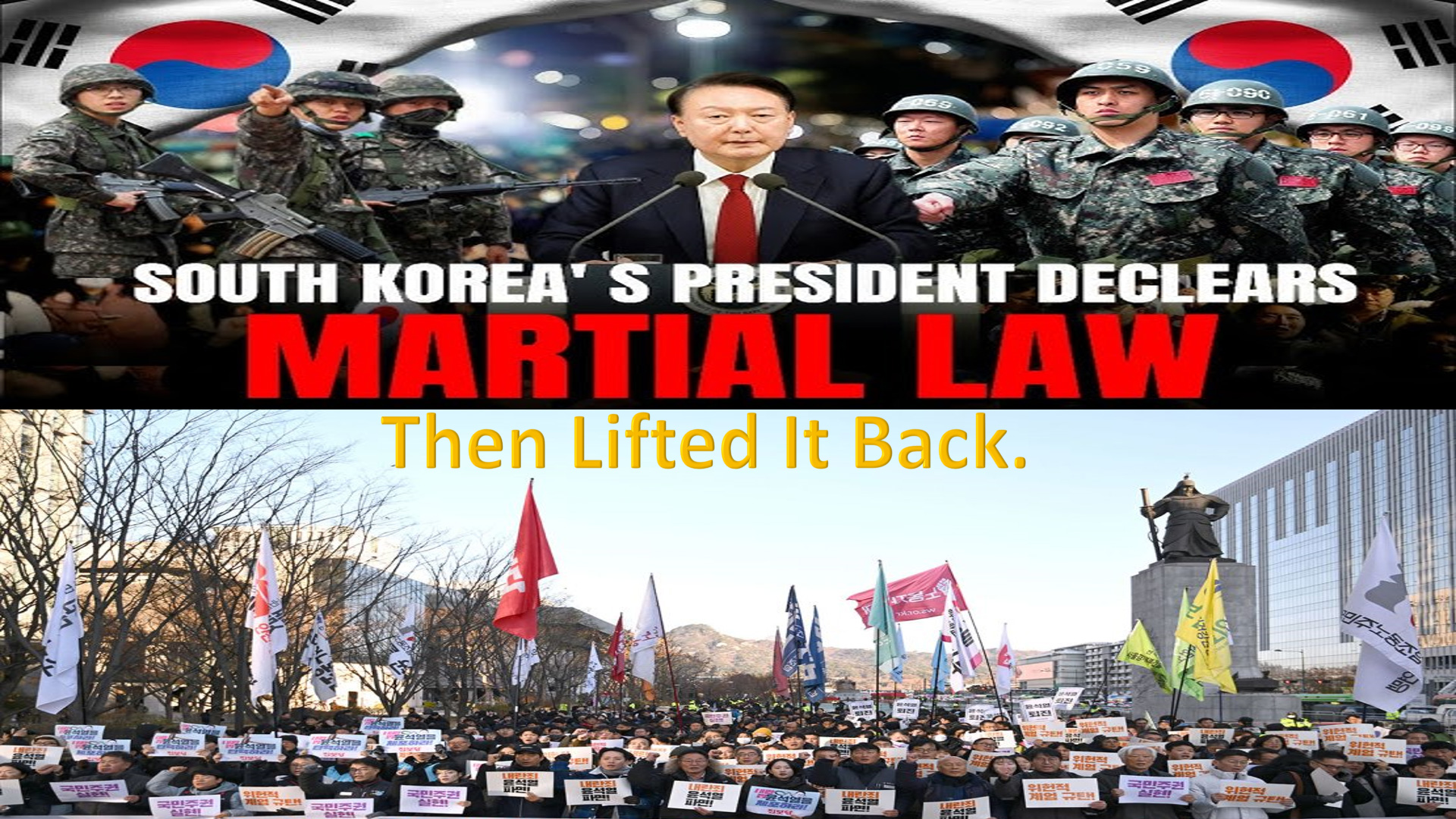
South Korea's President Yoon Suk Yeol is facing intense political turmoil after declaring martial law in response to what he described as a threat from anti-state forces. His abrupt and controversial decision triggered widespread protests and calls for his impeachment, with opposition parties accusing him of overstepping his powers and endangering democracy. The martial law, which lasted only six hours, saw armed forces surrounding the National Assembly and led to intense clashes between lawmakers and the military. While Yoon rescinded the order after the National Assembly voted overwhelmingly against it, his actions have ignited a political crisis that threatens his presidency.
The Martial Law Declaration
On a Tuesday evening, President Yoon made a startling announcement of martial law, citing a supposed plot by anti-state elements intending to destabilize the country. He accused opposition parties of supporting North Korea, which he framed as an existential threat to South Korea. However, Yoon provided no concrete evidence for these claims, leaving the country grappling with the sudden and unexplained declaration. Martial law grants the president broad powers to control the military and suspend civil rights, but it also requires legislative approval to remain in effect.
Yoon’s justification for the declaration—citing North Korea as a destabilizing force—appears to echo past South Korean authoritarian rulers who used similar rhetoric to justify martial law and suppress dissent. Throughout the late 20th century, South Korean leaders such as Park Chung-hee and Chun Doo-hwan invoked martial law to quell opposition movements, often blaming North Korea for internal unrest. However, experts have questioned whether the current political situation in South Korea warranted such a drastic measure, especially since the country is not currently in a wartime or emergency state.
Political and Public Backlash
The announcement was met with immediate and fierce resistance from both opposition parties and members of Yoon’s own conservative People Power Party. Within hours of the declaration, opposition lawmakers moved to impeach Yoon, calling his actions unconstitutional. The liberal opposition Democratic Party, which holds a majority in the 300-seat National Assembly, argued that Yoon had abused his power and undermined democracy. Within the assembly, a vote to lift martial law was passed unanimously, forcing Yoon to rescind the decree just six hours after its imposition.
The National Assembly’s rejection of martial law was not without drama. As armed soldiers surrounded the parliamentary building, lawmakers had to physically climb walls to enter and hold off the military by using fire extinguishers. In one of the most dramatic moments, Ahn Gwi-ryeong, a former news anchor turned politician, confronted a soldier pointing an assault rifle at her, shouting at him, “Aren’t you ashamed of yourselves?” The confrontation highlighted the intensity of the crisis, with both lawmakers and the general public shocked by the scale of military intervention in civilian affairs.
The swift and overwhelming parliamentary vote against the martial law highlighted the lack of support for Yoon’s decision within South Korea’s political establishment. Not only did the opposition strongly oppose it, but 18 lawmakers from Yoon’s own party also rejected his actions, signaling a significant rift within the ruling party. Faced with mounting pressure, Yoon rescinded the martial law order during a hastily arranged Cabinet meeting.
Alleged Anti-State Plot and Lack of Evidence
In his initial speech, Yoon presented an urgent need for martial law, claiming that anti-state forces were conspiring against the government. He also accused the main opposition parties of supporting North Korea, further stoking fears of a foreign-backed domestic rebellion. However, no evidence was provided to support these claims, leaving many questioning the legitimacy of his actions. Yoon’s government has long adopted a hardline stance toward North Korea, but his decision to invoke martial law based on vague allegations raised doubts about his judgment and intentions.
Critics argue that Yoon’s martial law declaration may have been more about political expediency than national security. In the face of growing opposition to his policies, Yoon’s move to invoke martial law may have been an attempt to consolidate power and suppress domestic dissent. The National Assembly has been controlled by the opposition since Yoon took office in 2022, and the president has struggled to get his agenda through a divided legislature. The timing of the declaration, coming after Yoon’s approval ratings had plummeted due to scandals involving both him and his wife, raised further suspicions about his motives.
The Constitutional Debate and Legal Issues
The South Korean constitution provides the president with the authority to declare martial law in situations of wartime or national emergency. Such declarations grant the president sweeping powers to suspend civil liberties, restrict the media, and limit the functions of the judiciary. However, the constitution also allows the National Assembly to revoke martial law with a majority vote, as was seen in this case. Many legal experts argue that Yoon’s actions exceeded his constitutional authority, particularly in suspending parliament’s operations and deploying the military to intervene in domestic politics.
Martial law in South Korea is a sensitive issue due to the country’s history of military dictatorships. South Korea’s transition to democracy in the late 1980s was shaped by years of military rule, particularly under the leadership of figures like Park Chung-hee and Chun Doo-hwan. Both leaders used martial law to suppress protests and maintain control during periods of domestic unrest. The legacy of such authoritarian rule has left a deep scar on the country’s political consciousness, making any form of military intervention in civilian affairs highly controversial.
Yoon’s decision to invoke martial law has rekindled fears of a return to the military-dominated politics of the past. While the constitution allows for such emergency powers, many South Koreans see martial law as a relic of authoritarianism, and its use is considered an overreach of presidential authority. This fear was exacerbated by the dramatic scenes of military forces surrounding the National Assembly, reminding many of the brutal crackdowns during South Korea’s authoritarian period.
Yoon’s Political Struggles
The martial law incident is just the latest chapter in Yoon’s troubled presidency. Since taking office in 2022, Yoon has struggled to navigate a deeply divided political landscape. The National Assembly has been dominated by opposition parties, making it difficult for Yoon to pass legislation or push through his policy agenda. In addition, Yoon has faced multiple corruption scandals involving him and his wife, further eroding his public support.
One of the most high-profile scandals involves allegations of influence-peddling related to a parliamentary by-election in 2022. Yoon and his wife are accused of using their political influence to ensure a particular candidate was chosen for the election. While Yoon has denied any wrongdoing, the scandal has severely damaged his credibility and approval ratings. The martial law declaration comes at a time when Yoon’s presidency is already under intense scrutiny, with many questioning his leadership and governance abilities.
Yoon’s move to invoke martial law has also been viewed by some as an attempt to distract from these scandals and shift the focus away from his political failures. With his political future uncertain, Yoon’s dramatic actions may be seen as a last-ditch effort to reassert control over a fractious political system. However, the backlash against his decision has only intensified calls for his resignation and impeachment.
A Troubling Legacy of Martial Law
South Korea’s history with martial law is deeply rooted in its past of military dictatorships. The country endured several decades of authoritarian rule, with leaders invoking martial law to suppress dissent and maintain control. The most infamous example of this is the 1980 Gwangju Uprising, when government troops violently quelled a pro-democracy protest, killing at least 200 people. The use of military force to crush civilian opposition has left a lasting scar on South Korean society, making any attempt to invoke martial law today highly contentious.
For many South Koreans, the events of the past few days have evoked memories of a dark period in the nation’s history. The imposition of martial law, even for a brief period, has reignited fears of a return to military rule. Despite the democratic progress South Korea has made since the late 1980s, the specter of authoritarianism remains a powerful force in the country’s political landscape.
Then What About Democracy Indexes, Are They Fraud?🤔
#V-Dem Democracy Index
South Korea- Rank 47 - Liberal Democracy
India- Rank 104 - Electoral Autocracy
#Economist Index
South Korea- Rank 22 - Full Democracy
India- Rank 41 - Flawed Democracy
Full Democratic South Korea Has Imposed Emergency Martial Law.. 😆
President Yoon Suk Yeol’s decision to declare martial law has plunged South Korea into a political crisis. His actions have sparked widespread opposition and calls for impeachment, with many questioning his motives and the legality of his decree. Also unstable South Korean situation can lead to fall in its economy, where India can get little benefit as investors may shift their funds. The martial law incident has reminded the country of its painful history with military dictatorships and reignited fears of a return to authoritarian rule. As Yoon faces mounting political and legal pressure, the future of his presidency hangs in the balance, and South Korea must grapple with the implications of this unprecedented move.

Physics, Chemistry, Biology and Geography.

Computer Programming, languages & their frameworks.
Economics, Accounts and Management.
Reviewing old and new books.

Ancient, Medieval, Modern, World History.
Indian Constitution, Politics, Policies, etc.

Everything related to International Affairs.

For all humanities topics, except History & Polity.

Anything related to entertainment industry.
Mainly Cricket but other sports too.
CS, IT, Services & Corporate Sector.
Comments
No comments yet. Be the first to comment!
Leave a Comment