Retribution in Red. The Echoes of Pahalgam lead to The Rise of Operation SINDOOR. | (Thu 15 May 2025 02:05)
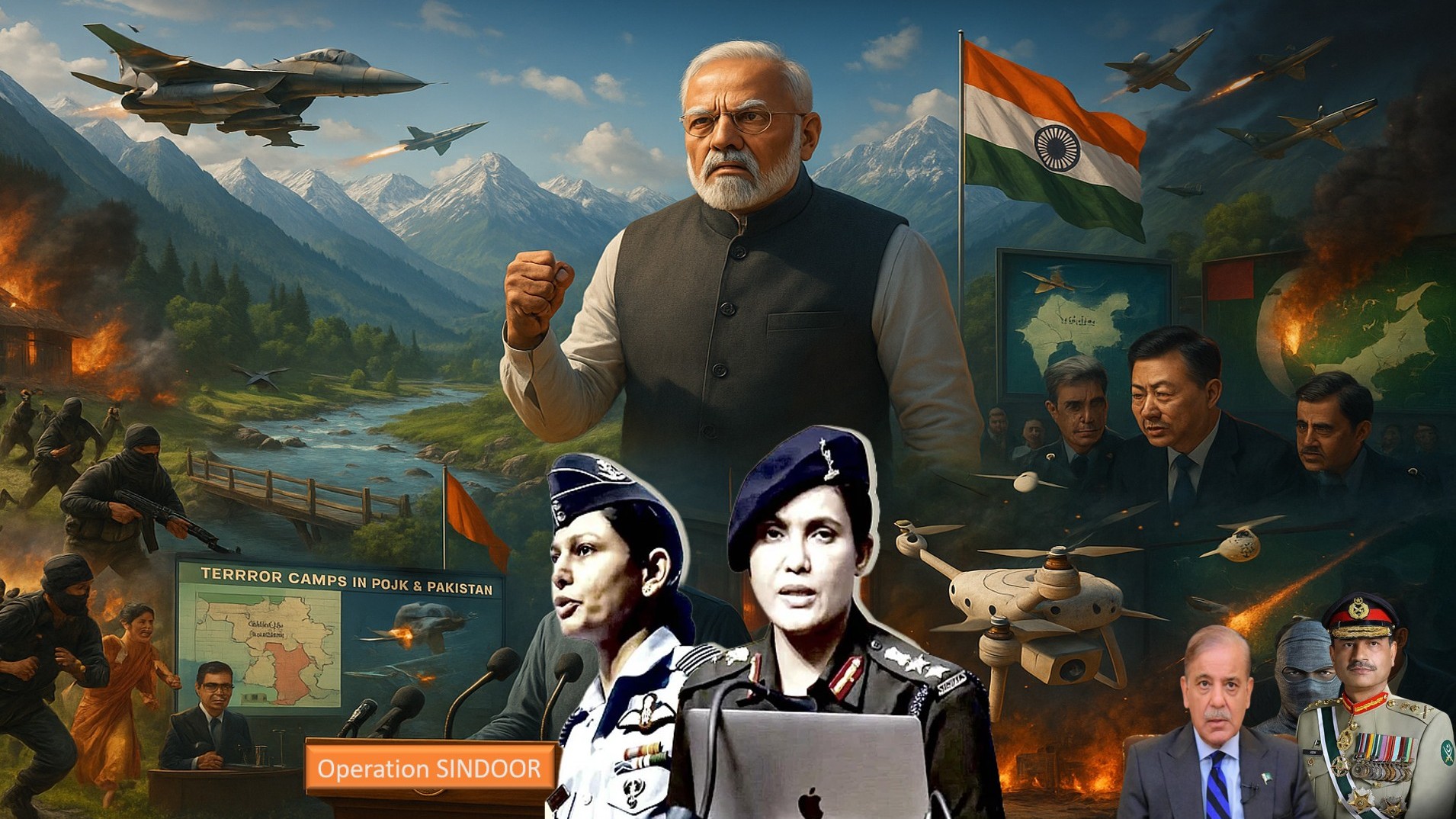
On the serene morning of April 22, 2025, the heavenly Pahalgam town in Jammu and Kashmir was shattered by an act of unimaginable horror. Pakistan-backed terrorists stormed the town, their boots trampling the peace of the valley.
With chilling precision, they interrogated tourist about their religion before executing 26 innocent souls.
This was no ordinary cross-border skirmish; it was a calculated attempt to ignite communal strife and fracture India’s unity from within. The nation stood stunned, but its resolve hardened. In response, India launched Operation SINDOOR, a meticulously crafted campaign to dismantle the terror infrastructure responsible for the massacre and to send an unequivocal message: India would not be broken.
The purpose of Operation SINDOOR was clear from the outset. It aimed to punish the perpetrators and masterminds behind the Pahalgam attack, obliterating their bases across the border in Pakistan and Pakistan-occupied Jammu and Kashmir (PoJK). India’s intelligence agencies conducted a microscopic scan of the terror landscape, identifying numerous camps and training sites operated by groups like Lashkar-e-Taiba, Jaish-e-Mohammed, and Hizbul Mujahideen. The operation was underpinned by a strict ethical code: only terrorist targets would be neutralized, with utmost care to avoid civilian casualties. This restraint was not a sign of weakness but a testament to India’s commitment to responsible warfare.
Pakistan, however, escalated the conflict. Over the week following the Pahalgam attack, it unleashed a barrage of drones and shelling targeting India’s religious sites. The Shambhu Temple in Jammu, a Gurdwara in Poonch, and Christian convents bore the brunt of these assaults. These were not random acts but part of a sinister strategy to deepen India’s communal divides. India’s response was swift and measured. On May 7, Foreign Secretary Vikram Misri addressed the nation, clarifying that Operation SINDOOR was a focused, non-escalatory campaign targeting terror infrastructure, not Pakistani military establishments. He warned, however, that any attack on Indian military targets would invite a proportionate response.
India’s retaliatory strikes were surgical. Radar installations in Lahore and facilities near Gujranwala were reduced to rubble, crippling Pakistan’s ability to coordinate further attacks. The strikes showcased India’s technological prowess, with Rafale jets, SCALP missiles, and HAMMER bombs bypassing Pakistan’s Chinese-supplied air defenses in a mere 23 minutes. The operation’s precision was lauded globally, with analysts like Tom Cooper describing it as a “clear-cut victory” that exposed Pakistan’s military vulnerabilities.
By May 10, the tide had turned. Reeling from heavy losses, Pakistan’s Director General of Military Operations (DGMO) reached out to his Indian counterpart, proposing a ceasefire. At 1700 hours IST, both sides agreed to halt all firing and military actions on land, air, and sea. But Pakistan’s commitment wavered. Post-ceasefire, a wave of UAVs and small drones intruded into Indian territory, targeting civilian and military areas. India’s multi-layered air defense, bolstered by the indigenous Akashteer system, intercepted these threats with ruthless efficiency. Field commanders were authorized to respond decisively to any further violations, ensuring Pakistan faced immediate consequences.
Beyond the battlefield, a fierce information war raged online. Pakistan launched a vicious campaign of lies and misinformation, aiming to distort the truth and sway global opinion. India countered with transparency and facts, exposing Pakistan’s manipulation tactics and discrediting its propaganda sources. Campaigns to promote media literacy empowered Indian citizens to discern truth from fiction, creating a resilient digital environment. India’s communication strategy was precise, highlighting Operation SINDOOR’s strategic successes without resorting to sensationalism.
The operation’s non-military measures were equally potent. In a historic move, India suspended the Indus Waters Treaty of 1960, declaring it in abeyance until Pakistan unequivocally renounced cross-border terrorism. This decision struck at Pakistan’s economic core, as the Indus river system sustains 80% of its agricultural land and 93% of its water use, supporting 237 million people and a quarter of its GDP. With Pakistan’s Mangla and Tarbela dams holding only 10% live storage capacity, any disruption in water flow threatened catastrophic agricultural losses, food shortages, and economic collapse. For India, the suspension unlocked the potential to develop reservoirs on the Jhelum and Chenab rivers, boosting irrigation and hydroelectric power in Jammu, Kashmir, Ladakh, Punjab, and Haryana. Prime Minister Narendra Modi’s words echoed across the nation: “Blood and water cannot flow together.”
India further tightened the screws by closing the Attari-Wagah border and suspending all bilateral trade with Pakistan. Exports of critical goods like onions were halted, and imports of cement and textiles banned, severing a vital economic lifeline. Pakistani nationals were deported, their visas revoked, and their participation in the SAARC Visa Exemption Scheme terminated. A total ban on Pakistani artists erased their cultural presence in India, from music releases to streaming platforms. Diplomatically, India isolated Pakistan, exposing its terror infrastructure on global forums and reducing the Pakistani High Commission’s staff in New Delhi from 55 to 30.
At the helm of this multidimensional response was Prime Minister Narendra Modi, whose leadership defined Operation SINDOOR. Despite being overseas on a diplomatic visit, Modi swiftly took command, balancing strategic restraint with assertive action. His decision to suspend the Indus Waters Treaty and authorize precision strikes was praised across party lines, with opposition leader P. Chidambaram commending the focus on high-value terror targets. Modi’s address to the nation on May 12 crystallized the operation’s ethos: “Operation SINDOOR is not just a name but a reflection of the feelings of millions… an unbroken pledge of justice.” He outlined a new national security doctrine: terrorist attacks would be treated as acts of war, with no distinction between terrorists and their state sponsors. India would not tolerate nuclear blackmail, striking decisively at terror hideouts.
The results of Operation SINDOOR were staggering. Nine major terror camps were obliterated, killing over 100 terrorists, including high-profile commanders like Yusuf Azhar, Abdul Malik Rauf, and Mudassir Ahmad, linked to the IC-814 hijack and Pulwama blast. Cross-border strikes redefined engagement rules, penetrating deep into Pakistan’s Punjab province and Bahawalpur. On May 9–10, India became the first nation to strike 11 airbases of a nuclear-armed state in a single operation, destroying 20% of Pakistan’s air force assets, including key fighter jets and personnel at Bhoolari Airbase. The Indian Army, Navy, and Air Force operated in seamless coordination, showcasing India’s joint military prowess.
India’s air defense superiority was unmistakable, neutralizing hundreds of Pakistani drones and missiles. The operation exposed Pakistan’s reliance on outdated air defense systems, while India’s technological edge shone through. Globally, the narrative shifted in India’s favor. Unlike past conflicts, world leaders backed India’s actions, recognizing its counter-terrorism focus. The Kashmir issue was decoupled from the strikes, reframing the conflict as a fight against terrorism alone.
Analysts lauded India’s approach. John Spencer, Chair of Urban Warfare Studies at the Modern War Institute, noted that Operation SINDOOR redefined India’s red lines, treating terror attacks as acts of war. Jennifer Zeng, in her article “Beg for a Ceasefire,” detailed India’s precise strikes and Pakistan’s subsequent defeat, highlighting Islamabad’s desperate call for a truce after suffering heavy losses.
As the dust settled, Operation SINDOOR emerged as a landmark in India’s strategic history. It was not merely a military campaign but a multidimensional assertion of sovereignty and resolve. By blending restraint with strength, India reshaped South Asia’s geopolitical landscape. Yet, Modi’s vision extended beyond Pakistan. As Chinese President Xi Jinping and Russian President Vladimir Putin celebrated their “friendship of steel” in Moscow, and global politics churned with shifting alliances, India recognized the need to look beyond its neighbor. The world demanded greater Indian attention, and Operation SINDOOR had positioned India as a formidable player on the global stage.
In the annals of history, Operation SINDOOR will be remembered as a principled retaliation, shaped by leadership, ethics, and precision. It was a story of a nation that, in the face of terror, chose not to fracture but to fight—decisively, justly, and unyieldingly.
However, It's tough to say, Pakistan won't do another adventure against India. See, state sponcered terrorism policy under the nuclear unmbrella quite which works for them. Unless India de-nuclearize Pakistan (very tough plan to execute), world will not let Pakistan doom beacuse it's too big to fail with nukes in arsenal and terror oufits living side by side. Hope, the new normal where India consider 'act of terorrism means act of war', and 'won't consider terror outfit different from their states', may give ample signal to Pakistan that India won't tolerate anymore such henious act. "My only hope is that the suspension of the Indus Waters Treaty might act as a magic wand—provided there is still some semblance of sanity left within Pakistan's military leadership which going through twin crisis - Imran Khan and BLA (Balochistan Liberation Army)."

Physics, Chemistry, Biology and Geography.

Computer Programming, languages & their frameworks.
Economics, Accounts and Management.

Reviewing old and new books.

Ancient, Medieval, Modern, World History.
Indian Constitution, Politics, Policies, etc.

Everything related to International Affairs.

For all humanities topics, except History & Polity.

Anything related to entertainment industry.
Mainly Cricket but other sports too.
CS, IT, Services & Corporate Sector.
Comments
No comments yet. Be the first to comment!
Leave a Comment