The Fall of Assad: The Syrian Civil War's Pivotal Turning Point | (Mon 09 Dec 2024 00:46)
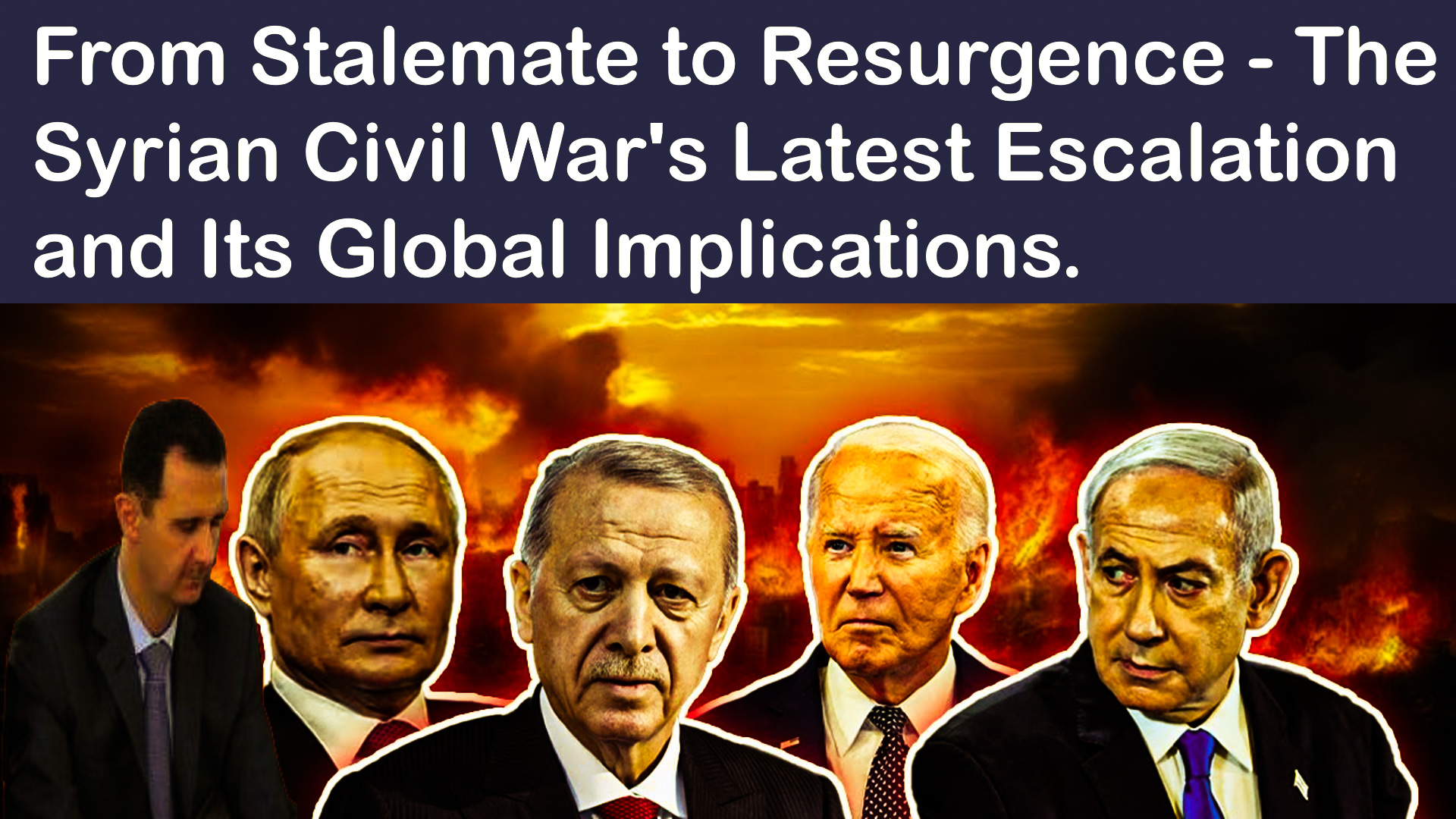
The sun cast its shadow over Syria in late November 2024, the scent of gunpowder and dust heavy in the air. For years, the war-torn nation had been locked in a brutal stalemate, its fractured lands ruled by the iron grip of President Bashar al-Assad’s regime and the restless ambition of rebel forces. Yet, a storm had been brewing, one that would soon unravel the power structures that had defined Syria’s past decade and a half.
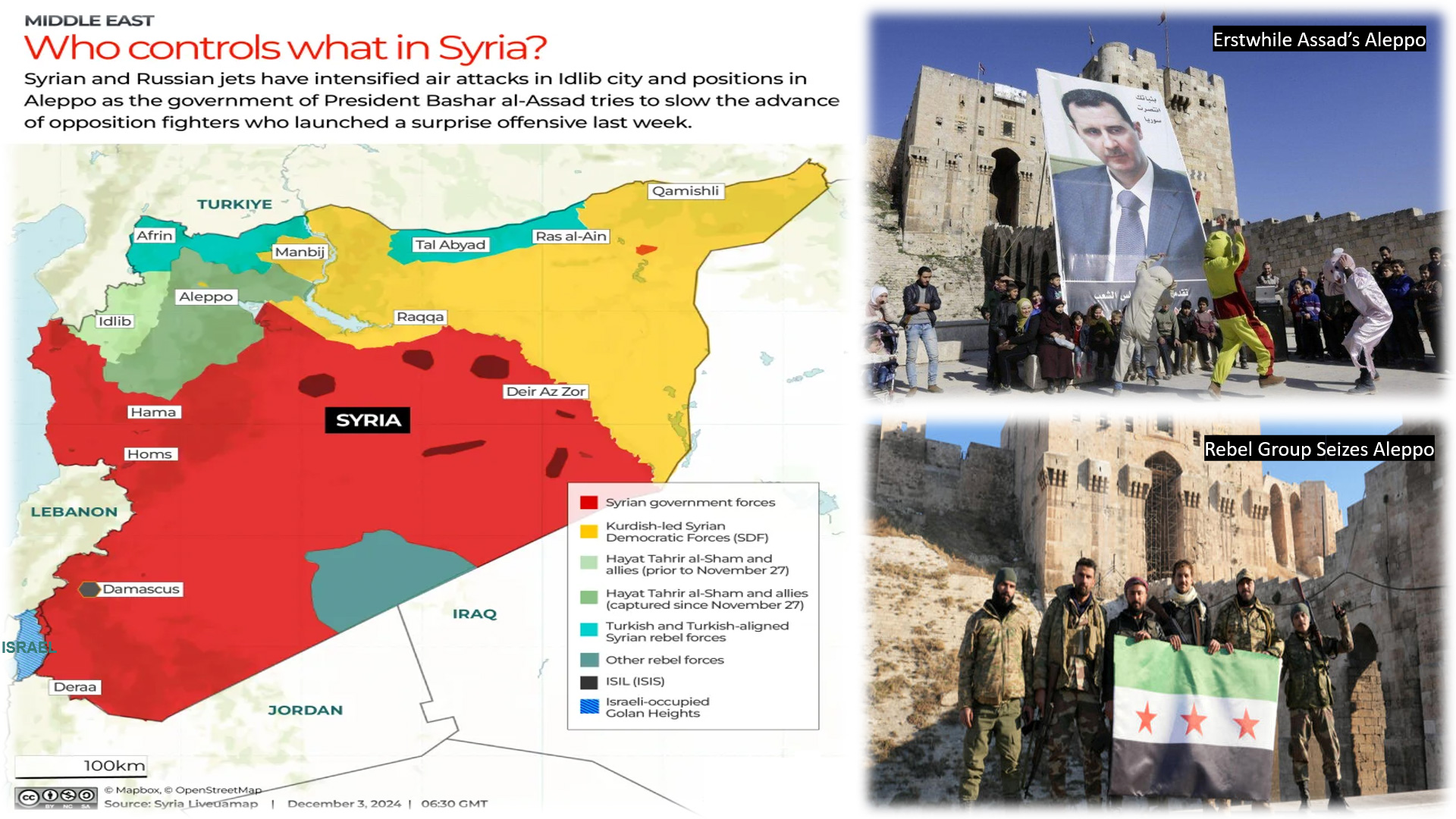
It all began on November 26, when Hayat Tahrir al-Sham (HTS), once an al-Qaeda affiliate now rebranded and seeking to shed its extremist past, launched a surprise offensive on Assad’s military positions in the northwestern heartland. This was not a mere skirmish. It was an act of defiance, a final push to overthrow a regime that had survived despite internal strife and external pressures for over 13 years. The very next day, Aleppo, the largest city in Syria, fell to the rebels. The capture was swift, almost surreal in its precision, as if the city itself had long awaited this moment of liberation.
HTS, under the leadership of Abu Mohammad al-Jolani, had long been a thorn in Assad’s side, controlling Idlib and surrounding areas like a beast in a cage. But now, its reach extended far beyond its old stronghold. Rebels, bolstered by fighters from the Syrian National Army (SNA) and Turkish-backed militias, surged forward, capturing strategic towns in Aleppo and Hama provinces. The once-stagnant frontlines dissolved, and Assad’s troops, exhausted and demoralized, retreated in disarray.
In Damascus, the seat of Assad’s power, whispers of his impending downfall spread like wildfire. The regime’s backers in Moscow and Tehran scrambled to provide reinforcements, but their capacity was depleted. Russia was enmeshed in its own war with Ukraine, its military stretched thin and unable to commit the overwhelming force it had in 2016. Iran’s resources were similarly stretched, its fighters weary from battles in Lebanon and escalating confrontations with Israel. Hezbollah, the Lebanese militia vital to Assad’s survival, had suffered significant losses in its war with Israel, and it too could offer no salvation.
Amidst this turmoil, a different kind of battle raged—a struggle for allegiances, a game of geopolitics that spanned continents. Turkey, once a fierce adversary of Assad, had seen its own interests shift. While it maintained support for rebel groups, its broader goals were complicated by the presence of Kurdish forces in the northeast, and by its complex dance with Russia and the U.S., each seeking influence in the new order.
The world watched as the rebels pushed south, seizing towns on the edges of Hama by December 5, their victory at Assi Square a symbolic echo of the anti-regime protests that had erupted in 2011. With each conquest, Assad’s hold over the country grew more tenuous. The specter of defeat loomed larger than ever, and on December 7, reports surfaced that Assad had fled the country, abandoning the remnants of his power to the advancing rebels.
By December 8, the end had come. Syrian state television broadcasted a message from a group of men standing before the Umayyad Mosque in Damascus, a sight that once echoed with the glory of Syrian civilization. It was now the scene of a new dawn. HTS commander Abu Mohammad al-Jolani stood before a crowd, his figure strong yet reflective. "Syria is cleansed," he declared, his voice carrying the weight of generations. To the people and the world, the fall of Assad was more than a military victory; it was the closing of one chapter and the uncertain beginning of another.
Al-Jolani’s ascent was not without its shadows. Born in 1982, he had joined the ranks of foreign fighters in Iraq in the wake of the 2003 invasion, only to be detained by the American military. When Syria’s civil war erupted in 2011, it was al-Jolani who would create the al-Qaeda-affiliated Nusra Front, a group that fought a brutal and bloody campaign against Assad's forces. But after a bitter split with ISIS, he distanced himself from extremist ideology and rebranded his faction as HTS. His efforts to shed his past and present a more palatable image had been met with suspicion, but now, amidst the celebrations, he appeared determined to lead Syria into a new era.
As Syria's government crumbled, the country teetered on the edge of chaos. Rebel-held territories, including the major city of Homs, fell with shocking speed. The rebels' newly developed Shaheen drones, capable of precision strikes with deadly accuracy, had proved vital to their advance. These drones, salvaged and adapted from Russian and Iranian prototypes, underscored a newfound technological edge. Despite Russia’s attempts to counterattack with airstrikes and renewed troop deployments, Assad's loyalist forces were unable to stem the tide. Meanwhile Iran who was busy with countering Israel in all sort of dog-fights, must be thinking how to build their nuke warheads at earliest, post fall of Assad.
While the world celebrated Assad’s ouster, the challenges of governance loomed large. Rebels, both seasoned and raw, were tasked with the Herculean effort of maintaining control and rebuilding a war-torn nation. Al-Jolani’s speech at the Umayyad Mosque, full of hope and determination, marked a vision for Syria that promised order and stability. But as reporters noted, the specter of HTS's extremist past still haunted the streets.
For the Syrian people, the fall of Assad was a long-awaited reprieve, a potential end to a war that had seen more than half a million lives lost and millions displaced. Yet, hope was mixed with apprehension. Would al-Jolani’s promise of governance and institutions hold true, or would the past come to reclaim the future?
Internationally, the repercussions were seismic. Russia, forced to reckon with its waning influence, faced a dilemma: Syria had been a cornerstone of its Middle Eastern strategy, a bulwark against Western influence and a staging ground for its own ambitions. For Iran, the loss of a proxy that had served as a vital link to Hezbollah and its ambitions in Lebanon was a blow to its strategic posture. Turkey, having invested heavily in the opposition, stood poised to claim some measure of influence in the new Syria. And Israel, while relieved that Iranian influence had been curbed, watched nervously as a new regime took shape, its history of extremist affiliations raising new questions.
Yet, one figure loomed large as the winner of this war—Recep Tayyip Erdogan. The Turkish president had taken a gamble on the opposition groups and now stood poised to shape the future of Syria, a power broker in a region where influence was everything. His government, having navigated its complex alliances and rivalries, would find itself uniquely positioned to play a decisive role in the formation of a new Syrian order. Russia heavily engaged with Ukraine, and Iran busy with Israel-Gaza-Hezbollah conflict, Assad found himself helpless. Meanwhile Turkey sided with Israel when it came to Syrian-conflict after rebel group asked help from Israel. May be the last geopolitical master stroke by Joe Biden.
As Syria breathed its first tentative breaths in freedom, the question remained: Would this be a new dawn or just another chapter in the cycle of violence that had defined the Middle East for decades? One thing was clear: The war had ended, but the peace was yet to come.

Physics, Chemistry, Biology and Geography.

Computer Programming, languages & their frameworks.
Economics, Accounts and Management.

Reviewing old and new books.

Ancient, Medieval, Modern, World History.
Indian Constitution, Politics, Policies, etc.

Everything related to International Affairs.

For all humanities topics, except History & Polity.

Anything related to entertainment industry.

Mainly Cricket but other sports too.
CS, IT, Services & Corporate Sector.
Comments
No comments yet. Be the first to comment!
Leave a Comment